December 16, 1964. Woolworth’s in Appleton, Wisconsin, ran its Christmas ad under the heading America’s Christmas Store. In it was a ten-ounce box of thin ribbon candy for 79 cents, “sold exclusively at Woolworth’s,” in pastels and stripes, and pretty enough, the ad said, to trim the tree and the door.
What Christmas candy did people buy in the 1960s? The December store ads of the decade show boxes of ribbon candy, bags of Christmas hard candy, chocolate-covered cherries, boxed chocolates such as the Whitman’s Sampler and Russell Stover, Hershey’s Kisses in red, green and silver foil, foil-wrapped chocolate balls and Brach’s candy by the pound. Here are 25 of them. Most come from dime-store ads: Woolworth’s, Kresge’s, Murphy’s, Grant’s, Newberry’s, Ben Franklin and King’s, a variety store in Idaho. A few come from the drugstore or the grocery. Each one is tied to a dated ad, with what became of it.
Watch the companion video
Our companion video counts all 25 down, from a candy-filled cane at Ben Franklin to the Woolworth’s ribbon-candy box.
1960s Christmas candy at a glance: all 25
The list follows the countdown in the video, from number 25 to number 1. The third column gives one dated ad for each. “Not confirmed” means we found no maker’s page selling it today, not that it is gone.
| # | Candy | One dated ad | Sold today? |
|---|---|---|---|
| 25 | Candy-filled cane | Ben Franklin, Amboy, Ill., Nov. 1969 | Not confirmed |
| 24 | Clear toy candy | Drugstore, Stroudsburg, Pa., Dec. 1962 | Still poured in Pennsylvania (2019 report) |
| 23 | Noel Candy Mix | Woolworth’s, Colorado Springs, Dec. 1964 | Not confirmed |
| 22 | Streamer Pops | Murphy’s, Washington Court House, Ohio, Dec. 1962 | Not confirmed |
| 21 | Candy-filled plastic ornament | Woolworth’s, Sikeston, Mo., Dec. 1967 | Not confirmed |
| 20 | Murphy’s own Christmas Mix | Murphy’s, Circleville, Ohio, Dec. 1968 | Not confirmed |
| 19 | Cut rock | Murphy’s, Washington Court House, Ohio, Dec. 1962 | Not confirmed |
| 18 | Harvest House Miniatures | Woolworth’s, St. Louis, Dec. 1961 | Not confirmed |
| 17 | Brach’s marshmallow Santas | Grocery, Appleton, Wis., Nov. 1962 | Not confirmed |
| 16 | Russell Stover Christmas chocolates | Drugstore, Circleville, Ohio, Dec. 1968 | Yes: Russell Stover |
| 15 | Melrose, Grant’s own brand | Grant’s, Appleton, Wis., Nov. 1963 | Not confirmed |
| 14 | The Christmas hard-candy bag | Newberry’s, Kingston, N.Y., Dec. 1961 | Not confirmed |
| 13 | Brach’s Christmas nougats | Grocery, Granite City, Ill., Dec. 1966 | Yes: Brach’s |
| 12 | The Whitman’s Sampler at Christmas | Drugstore, Appleton, Wis., Dec. 1960 | Yes: Russell Stover |
| 11 | Queen Anne chocolate-covered cherries | Grocery, Granite City, Ill., Dec. 1964 | Yes: World’s Finest Chocolate |
| 10 | Brach’s bridge mix and chocolate stars | King’s, Twin Falls, Idaho, Dec. 1961 | Not confirmed |
| 9 | The four-pound box of chocolates | Newberry’s, Stroudsburg, Pa., Dec. 1960 | No maker named in the ads |
| 8 | Schrafft’s at Woolworth’s | Woolworth’s, East Liverpool, Ohio, Dec. 1964 | Not confirmed |
| 7 | Foil-wrapped chocolate Christmas balls | Kresge’s, Appleton, Wis., Dec. 1964 | Not confirmed |
| 6 | Poinsettia chocolates | Woolworth’s, St. Louis, Dec. 1961 | Not confirmed |
| 5 | Filled candy and filled straws | Kresge’s, Arlington Heights, Ill., Dec. 1961 | Not confirmed |
| 4 | Hershey’s Christmas Kisses | Kresge’s, Appleton, Wis., Dec. 1964 | Yes: Hershey |
| 3 | Chocolate-covered cherries: Morningside and Cordially Yours | Murphy’s, Washington Court House, Ohio, Dec. 1962 | These two not confirmed; Cella’s and Queen Anne are |
| 2 | Brach’s by the pound | Woolworth’s, Colorado Springs, Dec. 1964 | Not confirmed |
| 1 | Ribbon candy | Woolworth’s, Appleton, Wis., Dec. 1964 | Yes: Hammond’s Candies, Denver |
1. Hard candy for the tree and the stocking
Candy-filled cane, Ben Franklin (#25)
A cane filled with candy, not a plain candy cane. In late November 1969, the Ben Franklin store in Amboy, Illinois, put one in its Christmas ad for 15 cents and promised 144 pieces of candy in each cane.
Clear toy candy (#24)
Clear toys were hard candy poured into metal molds. In Pennsylvania German homes, the Taber Museum notes, children set out a plate on Christmas Eve hoping for nuts, an apple or an orange, and clear toy candy, often shaped like farm animals, trains or Father Christmas. In 1960 a Gettysburg drugstore sold clear toys in nine-ounce bags for a quarter, and in December 1962 the Rea & Derick drugstore in Stroudsburg listed a pound box of Shelly’s Clear Toy Candies for 59 cents.
In 2007 a Philadelphia Inquirer columnist wrote that the hard-candy figures had long defined Christmas morning in the city and beyond. They were still being made in 2019: Lancaster Farming reported that Regennas, whose founder learned the craft in Lititz in the 1890s, still poured clear toy in the founder’s metal molds, some of them from the mid-1800s.
Noel Candy Mix, Woolworth’s (#23)
On December 17, 1964, Woolworth’s in Colorado Springs sold Noel Candy Mix for 39 cents a pound: red gumdrops, peanut brittle, milk chocolate drops and French crystal cremes, for the stockings and the candy dish. The ad names no maker.
Streamer Pops, Murphy’s (#22)
Candy for the tree. In December 1962, Murphy’s in Washington Court House, Ohio, sold a package of 29 fruit-flavored Streamer Pops for 29 cents and suggested hanging them on the tree or handing them to young holiday visitors. Two years later, Murphy’s in Circleville was selling Streamer Pops too.
Candy-filled plastic ornament, Woolworth’s (#21)
For a dime, the week before Christmas 1967, Woolworth’s in Sikeston, Missouri, sold a see-through plastic tree ornament holding candy and a surprise novelty toy.
Cut rock, Murphy’s (#19)
The dime store already called it old-fashioned. In December 1962, Murphy’s in Washington Court House sold its Christmas hard candy for 35 cents a pound, with “the old fashioned ‘cut rock’” in the assortment. Cut rock was a grocery candy too: in 1961 a supermarket in Cumberland, Maryland, had Brach’s cut rock, Brach’s ribbon candy and a Brach’s holiday mix at 29 cents a package.
The Christmas hard-candy bag, Newberry’s and Woolworth’s (#14)
In December 1961, Newberry’s in Kingston, New York, sold a 24-ounce bag of holiday-mix hard candy for 47 cents and pitched it as a stocking filler. At Woolworth’s in Sikeston in 1967, the bags carried one brand name in script, Sunny Lane: a pound of Christmas hard candy for 49 cents.
Filled candy and filled straws, Kresge’s (#5)
In December 1961, Kresge’s in Arlington Heights, Illinois, sold “fancy filled” candy at 49 cents a pound: filled peanuts, raspberries and straws, each piece in its own cellophane wrapper. Brach’s put filled straws in a Christmas bag: in December 1965, a drugstore in Circleville, Ohio, sold Brach’s Christmas Candy bags, filled straws among them, 11 ounces for 39 cents.
2. Mixes and the bulk candy counter
Brach’s by the pound (#2)
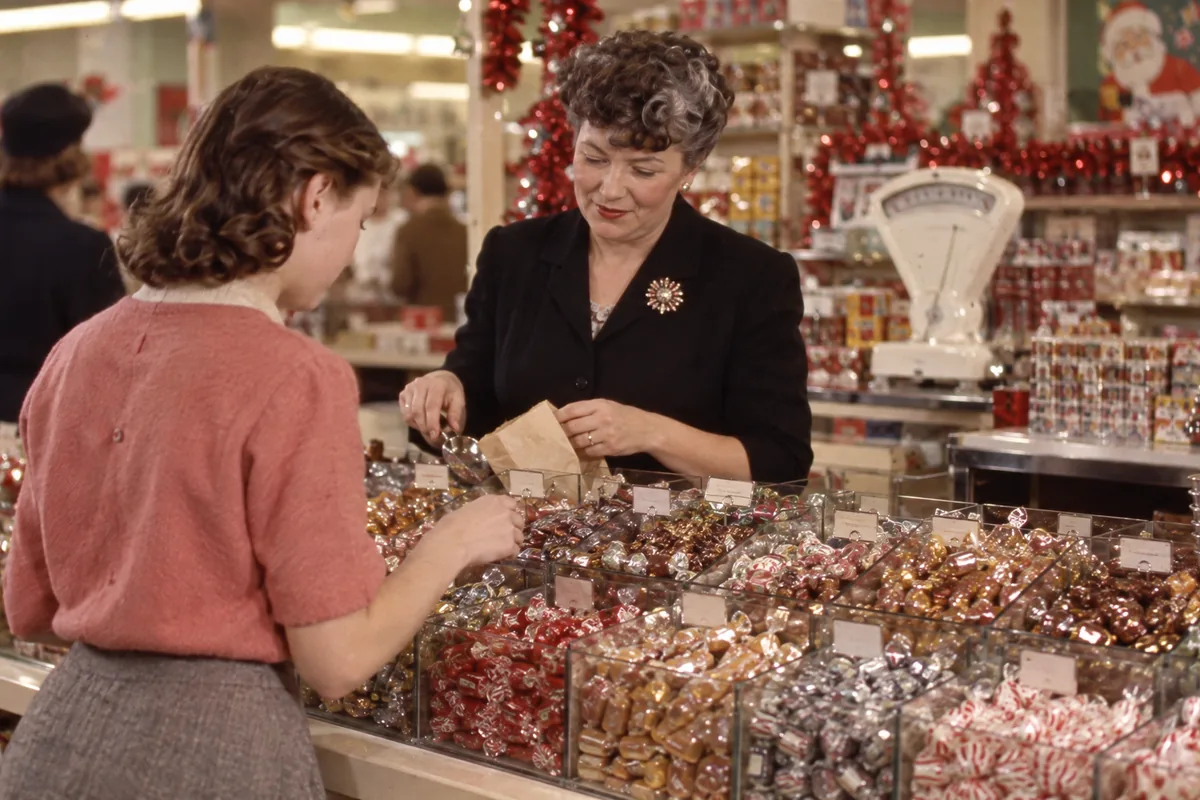
In February 1960 the trade journal The Manufacturing Confectioner described the usual variety-store setup: an end counter split by glass dividers into 16 to 24 bins, each with its own name card. Shoppers got a pan to fill and containers that measured a pound or more. Pricing, the journal said, was generally around 39 cents a pound; at the Woolworth’s on 34th Street in New York, a 69-cent bin of imported toffee sold far less than the 39-cent bin.
The Pick-A-Mix name has two stories. In 1960 the same journal said Bunte Brothers-Chase called its bulk assortment Pick-A-Mix. Brach’s own history says it introduced Pick-A-Mix in 1958, and the trademark “Brach’s Pick-A-Mix” was registered in November 1962.
At Christmas, Brach’s was on the dime-store counter. In Colorado Springs in 1964, Woolworth’s sold a Holiday Candy Mix loose at 37 cents a pound, “because it’s Brach’s,” the ad said. Brach’s, a Chicago company, was sold to American Home Products in 1966, and since 2012 it has belonged to the Ferrara Candy Company.
Murphy’s own Christmas Mix (#20)
Murphy’s put its own name on a mix. In December 1968, its store in Circleville, Ohio, ran a cartoon Santa telling shoppers to buy their Christmas candy at Murphy’s, beside the store’s own Christmas Mix, cut from 56 to 42 cents a pound.
Brach’s bridge mix and chocolate stars, King’s (#10)
Four days before Christmas 1961, King’s, a variety store in Twin Falls, Idaho, marked Brach’s milk chocolate bridge mix and milk chocolate stars down from 69 to 47 cents a pound, in one-pound bags. The next Christmas, the same store listed Brach’s chocolate stars, chocolate-covered peanuts and a Brach’s Christmas Mix.
Brach’s Christmas nougats (#13)
In May 1961 a grocer in Appleton, Wisconsin, described Brach’s Jelly Nougats as vanilla nougat studded with bits of fruit-flavored jelly. By 1966 Brach’s had a Christmas Nougats bag: a grocer in Granite City, Illinois, listed an 11-ounce bag for 39 cents among its Christmas candies (the ad doesn’t describe them), and in 1968 a Michigan grocer listed Brach’s Christmas Mint Nougats. You can still buy Brach’s Christmas nougats (see the questions below).
3. Boxed chocolates
Harvest House Miniatures, Woolworth’s (#18)
The week before Christmas 1961, Woolworth’s in St. Louis put Harvest House Miniatures on sale: a two-pound box for $1.57, a one-pound box for 79 cents. Woolworth’s also used the Harvest House name on its cafeterias; who made the chocolates, the ads don’t say.
Russell Stover Christmas chocolates (#16)
In December 1968, Bingman’s Drug Store in Circleville, Ohio, advertised Russell Stover Christmas Chocolates from $1.15. The company began in the Stovers’ Denver bungalow in 1923 and was selling boxes as Mrs. Stover’s Bungalow Candies by 1924. It was sold to Louis Ward in 1960 and to Lindt in 2014. Russell Stover still sells Christmas chocolates today.
Melrose, Grant’s own brand (#15)
W.T. Grant had a candy label of its own. In a “Play Santa at Grants” ad in Appleton, Wisconsin, in late November 1963, a one-pound box of Melrose chocolate-covered cherries was 88 cents, and the photo also shows Melrose peppermint patties. For Christmas 1964, Grant’s in Gettysburg, Pennsylvania, sold Melrose Holiday Chocolates for a dollar, down from $1.19.
The Whitman’s Sampler at Christmas (#12)
The Sampler dates from 1912, from the Philadelphia company Stephen F. Whitman founded in 1842, and according to a 2012 article in the trade magazine Snack Food & Wholesale Bakery, each box carried an index of the candies inside. In December 1960 a drugstore in Appleton, Wisconsin, sold it in Christmas wrapping, two dollars for the pound box. In 1961 the Rea & Derick drugstore in Gettysburg billed it as the most famous box of candy in America. Whitman’s became part of Pet Milk in the early 1960s and of Russell Stover in 1993, and Russell Stover still sells the Sampler in a Christmas box.
The four-pound box of chocolates (#9)
Four pounds in one box. Ten days before Christmas 1960, Newberry’s in Stroudsburg, Pennsylvania, sold four pounds of assorted chocolates, half light and half dark, for $2.66, down from $3.50. Murphy’s four-pound holiday box was $2.27 in Washington Court House in 1962 and $2.27 in Circleville in 1964. And in December 1969, Kresge’s in Escanaba, Michigan, cut a four-pound box from $3.84 to $2.88 for one hour only, from noon to one o’clock. None of these ads names a maker.
Schrafft’s at Woolworth’s (#8)
Two days before Christmas 1964, Woolworth’s in East Liverpool, Ohio, featured Schrafft’s chocolates it called its own exclusive: a pound for 98 cents, two pounds for $1.79. In June 1984, UPI reported that the Schrafft candy factory in Charlestown, Massachusetts, was closing, with about 800 jobs lost.
Poinsettia chocolates, Woolworth’s (#6)
In St. Louis in 1961, Woolworth’s sold a box of Poinsettia chocolates, a pound and three-quarters, for 99 cents. In Sikeston the next Christmas, Woolworth’s sold chocolates in a poinsettia box, also a pound and three-quarters for 99 cents, “to sweeten the Yuletide scene,” the ad said. The Woolworth’s ads name no maker. Brach’s did sell a Christmas assortment by that name: in 1963 a drugstore in Sedalia, Missouri, advertised Brach’s Poinsettia chocolates, five pounds for $3.49.
4. Chocolate-covered cherries
Queen Anne chocolate-covered cherries (#11)
On December 17, 1964, a grocer in Granite City, Illinois, listed Queen Anne chocolate-covered cherries among its Christmas candies, a 12-ounce box for 49 cents. Queen Anne started in 1921; a northwest Indiana paper reports that its factory on Hoffman Street in Hammond opened in 1923 and that chocolate-covered cherries became its signature product in 1948. In 2006, World’s Finest Chocolate of Chicago bought the brand.
Morningside and Cordially Yours (#3)
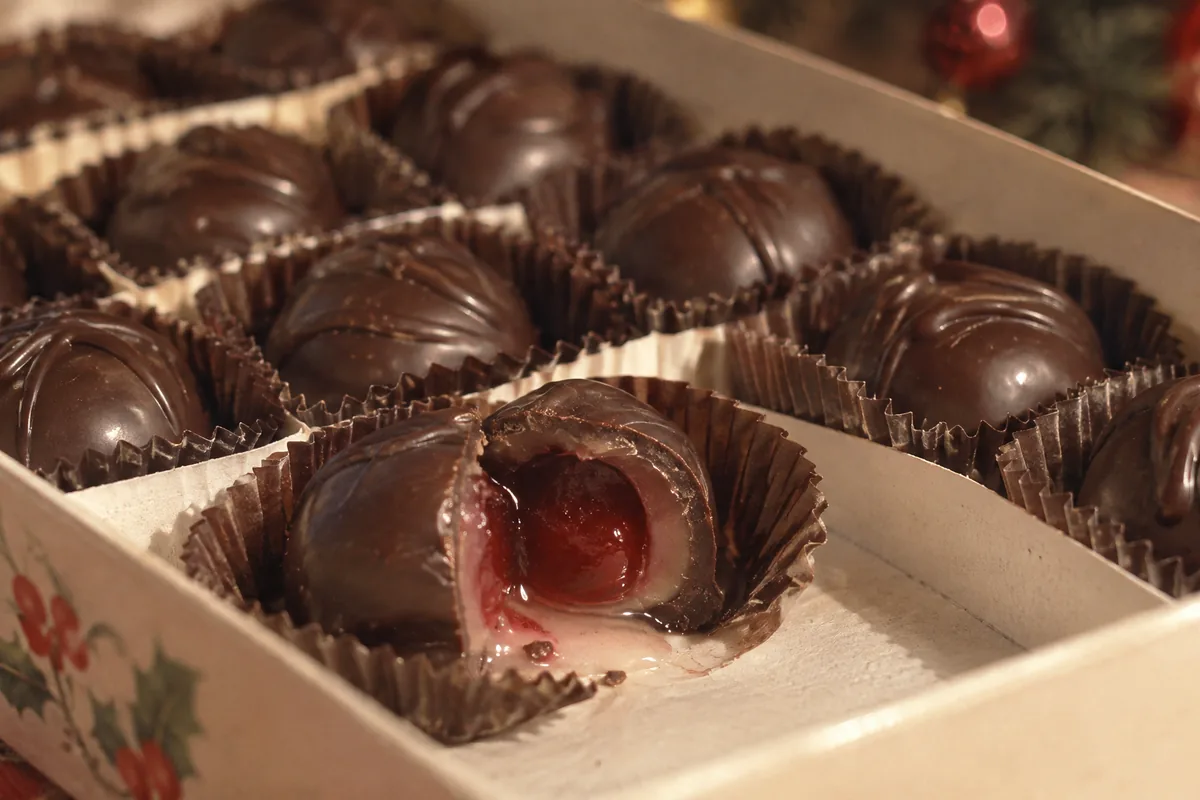
In December 1962, Murphy’s in Washington Court House, Ohio, sold Brach’s chocolate-covered cherries in a 12-ounce box for 55 cents; the box in the ad reads Morningside Cherries. At Christmas 1964, Woolworth’s in Appleton sold a ten-ounce box of chocolate-covered cherries, dark or light, for 47 cents, and the box in its drawing is Brock’s Cordially Yours.
Brock came from Chattanooga. The Tennessee Encyclopedia says the company brought out its chocolate-covered cherries in the 1930s and they caught on as a Christmas candy. In 1994 Brach’s bought a controlling interest, and the two became Brach and Brock Confections. We couldn’t confirm that either box is sold today. Chocolate-covered cherries are: Tootsie Roll, which added Cella’s in 1985, still sells them, and so does Queen Anne.
5. Santas, Christmas balls and Christmas Kisses
Brach’s marshmallow Santas (#17)
On November 28, 1962, a Piggly Wiggly in Appleton, Wisconsin, listed Brach’s chocolate marshmallow candy Santas, eight for 29 cents, among its St. Nicholas Eve specials. A year later a grocery in Escanaba, Michigan, had them at the same price. Sears sold a similar item in its 1961 Christmas catalog: chocolate marshmallow Santa pops, six for 98 cents, each in cellophane printed with Santa’s face.
Foil-wrapped chocolate Christmas balls, Kresge’s (#7)
Kresge’s called them chocolate ornaments. In December 1964, its stores in Appleton and Neenah, Wisconsin, sold solid chocolate Christmas balls in printed foil for 68 cents a pound, down from 89. Sears sold foil-wrapped chocolate balls by mail in 1961: a two-pound box of about 150 foil-wrapped milk chocolate balls, which Sears said came from Belgium. Today Russell Stover sells a Christmas Chocolate Ornament Assortment; we couldn’t confirm that it resembles the foil-wrapped balls.
Hershey’s Christmas Kisses (#4)
Hershey’s own archive says Kisses first came in red, green and silver foil at Christmas 1962. Two Christmases later, Kresge’s in Appleton sold Hershey’s Christmas Kisses, “ornament-bright in red, green and silver foil,” for 58 cents a pound, down from 79, for three days. Hershey still sells Kisses in Christmas foils.
6. Ribbon candy, number one
Back to the box from the start. The Woolworth’s ad of December 16, 1964, ran in Appleton and Neenah. It called the ribbon candy crinkled sugar candy, set in separate sections to keep its shape, and drew a flat tray of folded ribbons with Ribbon Candy in script on the lid. A year later in East Liverpool, Ohio, Woolworth’s weekly candy feature was Sunny Lane ribbon candy, a ten-ounce box for 67 cents.
Ribbon candy wasn’t only a dime-store candy. In 1961 a Maryland supermarket sold Brach’s ribbon candy for 29 cents a package, and in 1963 a drugstore in Sedalia, Missouri, had an eight-ounce bag for 29 cents.

A New England name in ribbon candy changed hands. F.B. Washburn of Brockton, Massachusetts, bought Sevigny’s in 1986 and kept making ribbon candy under that name. In 2016 its president told Boston.com that 60 percent of the company’s business was for Christmas, especially ribbon candy and traditional Christmas mixes. In 2019, Yankee magazine reported, Washburn said it was stopping ribbon candy and putting that part of the business up for sale. Who makes Sevigny’s now, we couldn’t confirm.
What happened to the dime stores
- Woolworth’s announced in July 1997 that it would close its last 400 five-and-dimes in the United States.
- Kresge’s: in 1977 the S.S. Kresge Company became the Kmart Corporation.
- Grant’s: by March 1976, Time reported, the bankrupt W.T. Grant chain was down to 155 stores from almost 1,100 five months earlier and headed for liquidation.
- Murphy’s and Newberry’s both ended up in the McCrory company. The Ames discount chain bought G.C. Murphy in 1985, and McCrory bought what was left of the Murphy chain in 1989. McCrory’s last 200 or so stores closed in 2001 and 2002; TribLive reported that the last to close was a former Murphy’s in Pittsburgh, in March 2002.
- Ben Franklin’s parent company went bankrupt in 1996, with about 930 stores, most of them owned by franchisees. In 2022 an Iowa TV station reported that the Ben Franklin stores still open ran independently, and that just two would be left in Iowa after a closing.
Common questions
Is ribbon candy still made?
Yes. Hammond’s Candies in Denver, which says it goes back to 1920, sells handmade ribbon candy on its own site (checked November 2026). The Sevigny’s name is less clear: its Massachusetts maker, Washburn, said in 2019 it was stopping ribbon candy, and we couldn’t confirm who makes Sevigny’s today.
Are Queen Anne chocolate-covered cherries still made?
Yes. World’s Finest Chocolate, which bought Queen Anne in 2006, sells Queen Anne cordial cherries in milk or dark chocolate. In the 1960s they were made in Hammond, Indiana; at Christmas 1964 a grocer in Granite City, Illinois, sold a 12-ounce box for 49 cents.
Does Brach’s still make Christmas nougats?
Yes. Brach’s (Ferrara) sells peppermint Christmas nougats with a green Christmas-tree design, and a Christmas nougats mix in peppermint, wintergreen and cinnamon. Neither page mentions jelly pieces like the Jelly Nougats a 1961 grocer described, and no 1960s ad we read shows the tree, so we can’t say the pieces looked the same.
Which Christmas candy was on your table, and which store did it come from? Tell us in the comments on the video.
Keep the memories going
- 1960s Christmas food gifts: 40 from the big stores and mail-order houses
- Vintage Woolworth’s Christmas: 30 things from its 1959–66 ads
- 1960s Christmas gifts: 40 from the big stores and their catalogs
- 21 dime store candies from the 1960s: which ones still exist?
- 1960s stocking stuffers: 30 things kids found on Christmas morning
- Old-fashioned Christmas candy: 40 homemade favorites
- How to make an old-fashioned Christmas candy box
- For candy bars and penny candy all year, see our candy cookbook, Penny Candy to Candy Bars.
Sources and further reading
Newspaper pages were read at the Internet Archive.
- Newspaper ads, Wisconsin: Appleton Post-Crescent, Dec. 22, 1960; May 8, 1961; Nov. 28, 1962; Nov. 28, 1963; Dec. 2, 1964; Dec. 16, 1964
- Ohio: Washington Court House Record-Herald, Dec. 12, 1962; Circleville Herald, Dec. 21, 1964; Dec. 13, 1965; Dec. 4, 1968; Dec. 12, 1968; East Liverpool Review, Dec. 23, 1964; Dec. 8, 1965
- Illinois: Dixon Evening Telegraph, Nov. 26, 1969; Arlington Heights Herald, Dec. 7, 1961; Granite City Press-Record, Dec. 17, 1964; Dec. 19, 1966
- Pennsylvania: Gettysburg Times, Dec. 8, 1960; Dec. 14, 1961; Nov. 25, 1964; Stroudsburg Daily Record, Dec. 15, 1960; Dec. 20, 1962
- Missouri: St. Louis Post-Dispatch, Dec. 18, 1961; Sikeston Daily Standard, Dec. 17, 1962; Dec. 20, 1967; Sedalia Democrat, Dec. 23, 1963
- Elsewhere: Colorado Springs Gazette Telegraph, Dec. 17, 1964; Kingston Daily Freeman, Dec. 5, 1961; Twin Falls Times-News, Dec. 21, 1961; Dec. 23, 1962; Escanaba Daily Press, Dec. 19, 1963; Dec. 13, 1969; Cumberland News, Dec. 14, 1961
- Sears Christmas Book, 1961; The Manufacturing Confectioner, February 1960; Official Gazette of the U.S. Patent and Trademark Office (Brach’s Pick-A-Mix registration)
- Hershey Community Archives: Hershey’s Kisses; Tennessee Encyclopedia: Brock Candy Company; Encyclopedia of Chicago: E. J. Brach & Sons; Encyclopedia.com: Brach’s Confections; Encyclopedia.com: Russell Stover Candies; Encyclopedia.com: Pet Incorporated; Encyclopedia.com: Ames Department Stores
- Snack Food & Wholesale Bakery, “Ageless at 100: Whitman’s Sampler,” June 15, 2012; NPR, July 14, 2014; Confectionery News, Feb. 10, 2006; Post-Tribune (Indiana), Jan. 16, 2022; Tootsie Roll Industries: timeline; Brach’s: About us
- Taber Museum (Lycoming County Historical Society): Clear Candies, 2019; Philadelphia Inquirer, Dec. 9, 2007; Lancaster Farming, Feb. 8, 2019
- Yankee: Sevigny’s ribbon candy; Yankee: Ribbon Candy | Up Close (2019); Boston.com, Nov. 9, 2016; UPI, June 1, 1984
- Spokesman-Review, July 18, 1997; Kresge Foundation: 1977 milestone; Time, March 22, 1976; TribLive, April 23, 2002; Roanoke Times, July 30, 1996; KCRG, Dec. 11, 2022
- Still sold today (checked November 2026): Russell Stover; Whitman’s at Russell Stover; Queen Anne; Cella’s; Brach’s peppermint Christmas nougats; Brach’s Christmas nougats mix; Hershey’s Kisses; Hammond’s Candies ribbon candy
Historical details checked November 8, 2026.