
Christmas morning, around 1965. Before the presents under the tree, there was the stocking, with a candy cane curving out the top and, down in the toe, an orange.
What were popular stocking stuffers in the 1960s? Here are 30 things a 1960s kid might have found in the stocking, from the candy cane at the top to the orange in the toe: candy, a comic book, crayons, and small toys like jacks, marbles, a yo-yo, a Slinky, Silly Putty, a Super Ball and a Matchbox car. Old ads, magazines and memories put about a dozen of them right in the stocking. Most of the prices we found were a dollar or less, and most of the 30 can still be bought today.
Watch the companion video
This article follows our video 30 Forgotten Stocking Stuffers 1960s Kids Found on Christmas Morning. The prices below come from old newspaper ads, catalogs, magazines and trade journals.
1960s stocking stuffers at a glance
| # | Stocking stuffer | A price we found | Still sold? |
|---|---|---|---|
| 30 | Candy cane | 29¢ for a package of Bobs canes (Ohio, 1962) | Yes |
| 29 | Gold chocolate coins | 1¢ (Brooklyn variety store, 1960) | Yes (Madelaine, for one) |
| 28 | Comic book | 10¢, then 12¢ by the end of 1961 (Dell: 15¢) | — |
| 27 | PEZ dispenser with Santa | — | Yes (a Santa ornament dispenser) |
| 26 | Jacks and a ball | — | Yes (Schylling) |
| 25 | Hollow chocolate Santa | 10¢ (1941 and 1950) | Yes (Lake Champlain Chocolates, for one) |
| 24 | Paddle ball | 25¢ (Fli-Back, about 1952) | Yes (Schylling) |
| 23 | Toy whistle | — | — |
| 22 | Marbles | — | Yes (Marble King, W.Va.) |
| 21 | Pick-up sticks | 39¢ (Massachusetts, 1969) | Yes (Schylling) |
| 20 | Kaleidoscope | $1 retail value (Steven Mfg., about 1960) | — |
| 19 | Harmonica | $1 (a Hohner-made child’s harmonica, 1966) | Yes (Hohner) |
| 18 | Cap gun and caps | 98¢ for the pistol (Missouri, 1965) | Roll caps, yes (Parris) |
| 17 | Satin mix | 29¢ a package (Nebraska, 1960) | A similar mix (The Swiss Colony) |
| 16 | Plastic army men | 100 for $1 (Marx, 1965) | Yes (Tim Mee Toy) |
| 15 | Colorforms | $1 (Dale Evans set, 1959) | A 70th-anniversary set in 2021 |
| 14 | Toy gyroscope | $1 and up (1958) | Yes (The Henry Ford’s shop) |
| 13 | Wacky Packages | — | A new Topps series in 2025 |
| 12 | Barrel of Monkeys | 79¢ regular (Long Beach, Calif., 1968) | Yes |
| 11 | Bendable Gumby | 77¢ (California, 1965) | Yes (Toysmith) |
| 10 | Life Savers Sweet Story Book | 49¢ for 12 rolls (Maryland, 1961) | Yes, now with six rolls |
| 9 | Box of crayons | 35¢ value (California, 1965) | Yes (Crayola’s 64) |
| 8 | Matchbox car | 49¢ (mid-’60s comic-book ads) | Yes (Mattel owns Matchbox) |
| 7 | Troll doll | 77¢ (California, 1965) | The originals are mostly collectibles |
| 6 | Duncan yo-yo | — | Yes (Imperial and Butterfly) |
| 5 | Slinky | About $1 (1968) | Yes (Just Play) |
| 4 | Silly Putty | $1 (1958); 77¢ (1965) | Yes (Crayola) |
| 3 | Super Ball | 98¢ regular (Nebraska, 1965) | Yes (Wham-O) |
| 2 | Nuts in the shell | — | Yes |
| 1 | The orange | — | Yes |
Prices come from single ads, catalogs, magazines and trade journals, and they varied by store and town. A dash means we didn’t find a price or didn’t check. “Still sold?” was checked in October 2026.
30 to 21: candy canes to pick-up sticks
30. The candy cane
In 1956, a Christmas editorial in Lancaster Farming, a Pennsylvania farm paper, remembered stockings filled “from an orange in the toe to a candy cane curving out the top.” So the list starts at the top.
In December 1962, an ad in Salem, Ohio, had a package of Bobs Candy Canes at 29 cents. Bobs Candies of Albany, Georgia, had help with all those crooks. A Catholic priest, Father Gregory Keller, invented a machine that bent the end of each stick into a crook, and he shared the patent, granted in 1960, with Bob McCormack of Bobs. The New Georgia Encyclopedia says the Keller Machine let Bobs mass-produce the hooked candy cane, and that by the end of the 1950s the company was turning out 1.8 million sticks of candy a day.
You may have heard that a choirmaster in Cologne bent the first candy canes in 1670. Snopes found that the story exists only as anecdote, recorded no earlier than the mid-20th century, and that the “J for Jesus” versions were promoted in inspirational books of the 1990s.
Still sold? Yes, by the box at Christmas.
29. Gold chocolate coins
Milk chocolate wrapped in gold foil, often sold in a little mesh bag. In November 1960, The Manufacturing Confectioner, a candy trade journal, reviewed chocolate coins bought at a chain variety store in Brooklyn. The price was one cent.
They belonged to more than one tradition. In 1961, Loft’s advertised “Milk Chocolate Coins in gold mesh bag” as Hanukkah gelt, and The Year and Our Children, a Catholic family guide to the church year, mentions little bags, “the kind you buy chocolate coins in at the drugstore.”
Still sold? Yes. Madelaine, for one, makes gold chocolate coins in the United States, in little mesh bags.
If a penny at the variety store brings back the candy counter, we have a free list of 21 dime-store candies from the 1960s, and which ones still exist.

28. A comic book
For years, a comic book cost a dime: Comichron, a comics-history site, says comics were mostly 10 cents until 1961. Dell went to 15 cents early that year, and most of the other publishers went to 12 cents by the end of it. DC even printed a notice to its readers explaining why. When Gold Key started up in 1962, comics historians say, its covers bragged “Now Only 12 cents.”
By February 1962, the Sikeston Daily Standard in Missouri was reprinting a Kansas editor’s joke about “the perils of inflation now that 10-cent comic books cost 12 cents.” So a comic in an early-’60s stocking might have cost a dime, 12 cents, or, for a Dell, 15 cents. It depends on the Christmas.
27. A PEZ dispenser with Santa on it
PEZ came to the United States in 1952, the company says, and in 1957 it put a three-dimensional character head on top of its dispenser. The first, according to PEZ, was a Halloween witch; Popeye followed in 1958 as the first licensed character.
The early Santa was different. Collectors’ guides show a 1950s Santa that was a whole little figure, Santa from top to bottom, instead of a head on the usual rectangle.
Still sold? Yes. PEZ’s own shop lists a Santa Claus ornament dispenser.
26. Jacks and a rubber ball
You tossed the ball, scooped up one jack and caught the ball. That was “onesies.” Then two at a time: “twosies.” Whether the ball could bounce first depended on whose rules you played by.
In April 1960, the trade paper Billboard described a set of jacks and a ball “packed in poly bag with bright header”: a little plastic bag with a bright card across the top. The National Toy Hall of Fame inducted jacks in 2000, and The Strong museum lists classic American versions of the game such as Eggs in the Basket and Pigs in the Pen.
Still sold? Yes. Schylling sells metal jacks with a rubber ball.
25. A hollow chocolate Santa
In 1937, ads had hollow chocolate Santas at a nickel and a dime. In 1941, a candy trade journal bought one at a five-and-ten to review it: about two and a half ounces of chocolate, for ten cents. Some 1950 ads still had them at a dime. R.M. Palmer of Pennsylvania, a hollow-chocolate company founded in 1948, added Christmas novelties in the 1960s.
One collection of North Carolina memories, published in 2014, recalls a Christmas when “Santa traveled light”: a new shirt, a spinning top, “oranges, nuts, and my favorite — a hollow, chocolate Santa.”
Still sold? Yes, at Christmas. Lake Champlain Chocolates in Vermont, for one, makes a hollow “Jolly Chocolate Santa.”
24. The paddle ball
A paddle, a rubber ball and a long elastic string. In 1958, The Personnel Administrator, a magazine for personnel managers, described the red mesh stocking that big companies gave children at their Christmas parties. That stocking, it said, “generally contains such standard toys as a yo-yo, paddle ball, patience puzzle or tricks.”
One maker was Fli-Back of High Point, North Carolina, in business since the early 1930s, which called itself the “World’s Largest Distributor of Paddle & Ball Games.” In a trade ad from around 1952, Fli-Back paddle ball games were a quarter. Fli-Back wasn’t alone: in 1937, Newsweek wrote up a paddle-ball fad, with competing sets named Bo-Lo, Rick-Rack and Fli-Back. And in the 1950s, a 3-D movie’s paddle-ball scene had a Fli-Back tie-in.
Still sold? Yes. Schylling makes one, sold at Ace Hardware.
23. A toy whistle
A toy whistle turns up in more than one old account of the Christmas stocking. In Ira Henry Freeman’s 1960 book Out of Burning, the narrator finds a stocking “filled with penny candy, bubblegum, a whistle, all the usual stocking stuffers.” And in 1965, the writer Ralph Schoenstein looked back on “the tiny surprises that filled my stocking: the whistles and marbles and bubble pipes that were inexpensive.”
22. A bag of marbles
Marbles were in that same 1965 stocking memory, right beside the whistles and the bubble pipes.
The Strong museum says alabaster “alley taws” made better shooters than the cheaper clay “commoneys,” and that parents frowned when kids “lost their marbles” in games of chance. It also says a German glassblower’s special scissors, in the mid-1800s, first made glass marbles affordable. The National Toy Hall of Fame inducted marbles in 1998.
Still sold? Yes, and still made in the U.S. Marble King makes them in Paden City, West Virginia, and the company says it can turn out upwards of a million marbles in a single day.
Jacks and marbles also turn up in our story on five-and-dime toys kids bought with pocket change.
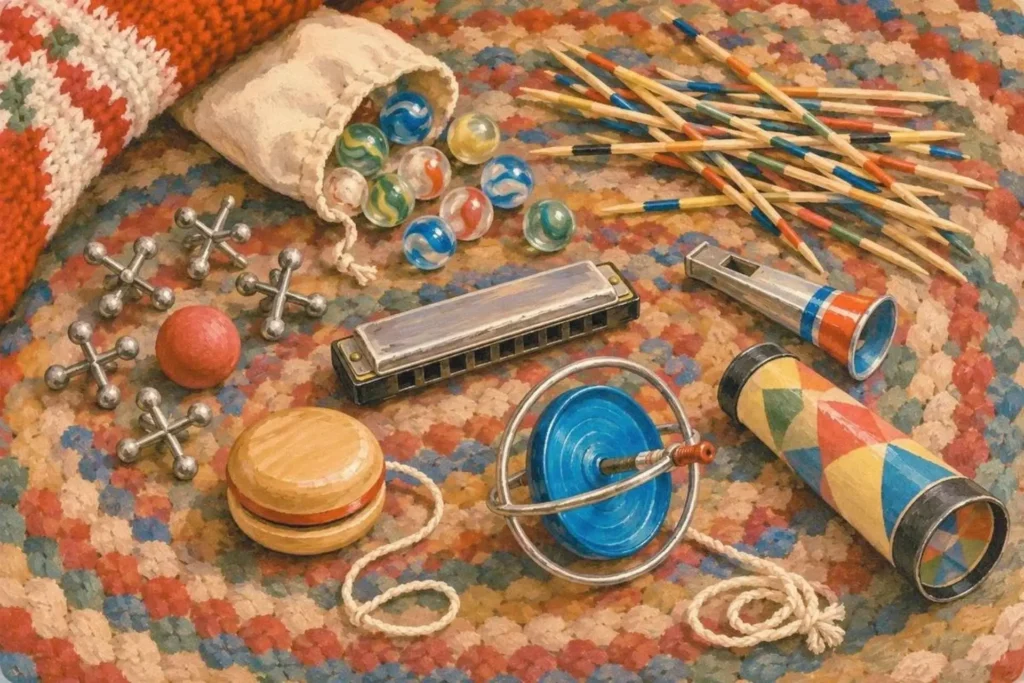
21. Pick-up sticks
All the sticks were dropped in a heap on the table. Then, one at a time, you tried to lift a stick without moving any of the others. If another stick moved, your turn was over.
In 1966, a Christmas-season ad in East Liverpool, Ohio, listed Lakeside Pick-up Sticks, and in 1969 a set was 39 cents in an ad in Newton, Massachusetts. Keep the Lakeside name in mind: it comes back with Barrel of Monkeys and Gumby.
Still sold? Yes. Schylling makes a set in a wooden box with a sliding lid.
20 to 11: kaleidoscopes to Gumby
20. A kaleidoscope
You held it up to the light, looked in and turned it. The loose bits of color inside tumbled, and mirrors in the tube turned them into a new pattern.
One maker billed itself “The Kaleidoscope King”: Steven Manufacturing of St. Louis, which put the retail value of its kaleidoscope at one dollar around 1960. Around 1962 it was making an oversize Disney kaleidoscope, and by 1968 the Kaleidoscope King had moved to Hermann, Missouri.
19. A harmonica
In 1963, a toy story that ran in at least two newspapers said a toy keyboard “belongs in the Christmas stocking along with the harmonica.” And a 1966 ad in Carmel Valley, California, listed a harmonica under “Stocking Stuffers.”
That same year, Billboard mentioned a one-dollar child’s harmonica made by Hohner, and Hohner’s American office said harmonica business had more than doubled. Billboard gave a good share of the credit to Bob Dylan. A 1964 book on music for exceptional children recommended a “simple one-key harmonica.”
Still sold? Yes. A music retailer lists Hohner’s four-hole beginner harmonica for kids.
18. A cap gun and a few rolls of caps
A 1965 ad in Sikeston, Missouri, had a Texan Jr. repeater cap pistol for 98 cents. The caps came on paper rolls, sold by the number of shots: 20 rolls meant 1,000 shots, and a jumbo pack of 50 rolls meant 2,500.
Even then, at least one writer said prices weren’t what they used to be. A humorist wrote in 1960 that in his day, a cap pistol “cost a quarter.”
Still sold? Roll caps, yes. Parris sells a two-roll pack good for 1,200 shots.
17. Satin mix
Shiny little pillows of hard candy, some of them with a filling. A 1933 ad in Santa Ana, California, already lists “stuffed satin mix.” In 1960, an ad in Lincoln, Nebraska, sold Roxbury Satin Mix for 29 cents a package, with a four-word pitch: “The kids love it.” In 1969, an ad in San Rafael, California, had satin mix at 49 cents, right beside ribbon candy.
Still sold? An old-fashioned Christmas hard candy mix is, pillows and all. The Swiss Colony sells one by the tin.
16. A bag of plastic army men
In October 1965, Airfix Magazine, a British hobby magazine, pointed out what American kids paid: “The Marx soldiers are sold, 100 to a bag, for a dollar in the United States.” That’s about a penny a soldier. Another maker, Multiple, packed its figures 60 to a bag.
Still sold? Yes, and still made in America. Tim Mee Toy sells World War II army men sets, “proudly manufactured in the United States.”
15. Colorforms
Flat stick-on shapes that came with their own board. They came off cleanly and could be used over and over, so you could build a scene, take it apart and build it again. A 1953 education magazine described sets with 70 flat stick-on pieces to a page.
A Dale Evans Western Dress-Up set was a dollar in a 1959 ad. And in December 1969, a toy shop’s ad in Newton, Massachusetts, listed Colorforms among its “toys and stocking fillers.”
Still sold? In 2021, PlayMonster marked 70 years of Colorforms with an anniversary set.
14. A toy gyroscope
A heavy little wheel inside a round frame. You wound a string around its axle and pulled, and you could set it spinning on your fingers.
In December 1958, the magazine Science News Letter said a gyroscope, “$1 up” in the stores, “makes a good stocking-stuffer.” And a December 1967 ad called it a “favorite toy,” complete with its winding string.
Still sold? Yes. The Henry Ford museum’s shop sells one and traces that model back to the 1910s. It was later sold as the Chandler gyroscope; in the first half of the 1900s, the shop says, it was common in five-and-dime stores, and Tedco bought it in 1982.
13. Wacky Packages
If your Christmases ran into the late ’60s, you may remember these. In 1967, Topps launched cards that spoofed well-known brands, and a young Art Spiegelman, who later created Maus, drew the first series. The first ones had to be punched out, licked and stuck.
The brand owners weren’t laughing. Topps says cease-and-desist letters came in, and some of the cards were pulled.
Still sold? Topps put out an all-new series in 2025.
12. Barrel of Monkeys
You hooked one plastic monkey onto another and lifted them out of the barrel in a long chain. A 1967 ad in Lincoln, Nebraska, counted 12 chimps in the barrel (“Lift the 12 chimps & you’re champ”), and Christmas ads that year called it a test of “your steady nerve.”
There’s that Lakeside name again: Lakeside registered a copyright on it in 1965. In 1968, an ad in Long Beach, California, had a barrel at a regular 79 cents, and a Wisconsin store marked it down that December from 88 cents to 61.
Still sold? Yes.
11. A bendable Gumby
Gumby started as a clay figure on television. The Henry Ford museum says Art Clokey introduced him on the Howdy Doody show in 1955 and ’56, and bendable Gumby toys soon followed.
Lakeside made Gumby toys, too. A 1966 Christmas catalog had a bendable Gumby for a dollar, and in an October 1965 ad in Porterville, California, Gumby was 77 cents. Hold on to that ad. It comes back in the top ten.
Still sold? Yes. Toysmith makes a bendable Gumby.
The stocking that came already filled
Before the top ten, the stocking itself. Some came already filled: a red mesh stocking with a printed card across the top, packed with candy and little toys.
They’re older than you might think. In January 1937, The Manufacturing Confectioner reviewed a red mesh candy stocking with a printed tab on top, and in February 1947 it reviewed one holding two ounces of candy, bought at a department store for 19 cents. The Maynard Historical Society in Massachusetts has an unopened Christmas stocking from the town’s Woolworth’s, from around 1940.
By 1958, big employers handed them out at company Christmas parties. That year, The Personnel Administrator noted that “Large plants have generally selected the same red mesh stocking with candy and toys.”
In 1960, an ad in Palm Springs, California, had candy-and-toy stockings from a dime to 79 cents. And in 1939, a St. Louis store even sold a red mesh stocking full of toys for the family dog, for 59 cents.
Still sold? Yes. Party suppliers sell them, paper header and all.

10 to 1: Life Savers to the orange in the toe
10. The Life Savers Sweet Story Book
A gift box shaped like a book, with rolls of Life Savers inside. In the ’50s and ’60s it held twelve 5-cent rolls, a 60-cent value, and stores sold it for less: 49 cents in Cumberland, Maryland, in 1961, and 45 cents there in 1964. In 1968, ads still offered twelve rolls for 49 cents.
By 1972, some ads said ten rolls. In 1974, an ad in Dixon, Illinois, called it “Ideal for stocking stuffing!”
Still sold? Yes, but a current listing shows six rolls, all Five Flavor.
9. A box of crayons
Crayons made the stocking-stuffer lists, too. In December 1965, an ad in Carmel Valley, California, headed “Christmas Stocking Stuffers” paired a box of crayons, a 35-cent value, with a 25-cent coloring book.
Then there was Crayola’s box of 64. Crayola says it came out in 1958 as the first box with a built-in sharpener, and the Smithsonian says so, too. In 1961, Crayola boxes ran from six for a dime up to 72 for $1.98, and by 1969 the box of 64 was regularly a dollar. The Smithsonian has one of those 1958 boxes, donated at the box’s 40th-birthday celebration, with Captain Kangaroo himself, Bob Keeshan, on hand.
Still sold? Yes. The box of 64, sharpener and all, is still on the shelf.
8. A Matchbox car
Small enough to fit in a matchbox. That was the idea. As The Strong museum and Mattel tell it, Jack Odell shrank a toy so his daughter could take it to a school that allowed only toys that fit inside a matchbox. Britain’s National Archives notes that the tiny size shaped the packaging, and the Matchbox name itself.
They came from England, made by Lesney, and mid-’60s comic-book ads priced them at 49 cents each. A curator at The Strong put the appeal simply: it didn’t need power, it was quiet, and it was inexpensive. Kids collected them, and comic-book ads even sold plastic displays that held five cars apiece. In December 1963, an ad in Newton, Massachusetts, put it plainly: “No stocking is complete without a Matchless Matchbox.”
In 1968, Mattel answered with Hot Wheels, built, as The Strong puts it, “to surpass the popular English Matchbox brand.”
Still sold? Yes. Today Mattel owns Matchbox, too, and in October 2026 Matchbox: The Movie began streaming on Apple TV.
7. A troll doll
Wild hair, a wrinkled face and wide eyes. In the early ’60s, they were sold as “Good Luck Trolls,” and Smithsonian magazine says children were encouraged to rub that hair for good fortune. It also says aviator Betty Miller carried one as a good-luck charm on her famous flight.
They came from a Danish woodcarver, Thomas Dam, and Smithsonian says Americans bought more than a million Dam trolls in 1964 alone. Look-alikes were on sale by then, too, and a 1965 court ruling left the design unprotected in the United States. In that October 1965 Porterville ad, troll dolls were 77 cents, the same as Gumby.
Still sold? Today the originals mostly turn up as collectibles.
6. A Duncan yo-yo
In 1964, ads in at least two newspapers promised, “Now you can perform such famous tricks as ‘Walk the Dog’ and ‘Rock the Cradle’ with a genuine Duncan Yo-Yo!” A 1965 paper asked: “Can you rock the baby? Walk the dog? Do round the world?” Duncan sent traveling demonstrators, many of them Filipino, around the country to hold contests, the Smithsonian notes. A Christmas 1962 ad in Hope, Arkansas, listed models including the Butterfly, the Imperial and one called the “Shrieking Sonic Satellite.”
Then Duncan lost its own word. In 1965, a federal appeals court ruled that “yo-yo” was a descriptive term, not Duncan’s trademark. The court had heard testimony that “yo-yo” “is a Filipino word in all dialects.”
Still sold? Yes. Duncan still sells the Imperial and the Butterfly.
5. The Slinky
On television, it walked down the stairs all on its own. At home, The Strong museum points out, most household steps were too tall and wide for a long trip. As far back as 1953, a hardware-trade catalog had sold it as the spring that “walks down stairs just like it was alive!”
Richard and Betty James borrowed $500 to make it, and Betty found the name in the dictionary. At Gimbels in Philadelphia, in November 1945, the first 400 sold out in about an hour and a half, The Philadelphia Inquirer reports, at a dollar apiece. In the ’60s it was still about a dollar: a 1968 college physics textbook told students a Slinky was available “in any toy store for about $1.” The jingle came from a 1962 TV campaign.
Still sold? Yes. The Slinky is still made, now by Just Play.
4. Silly Putty, in its plastic egg
The ads spelled out the trick: “Shape it like a ball — it bounces! Pull it slowly — it stretches! Pull it quickly — it breaks!” That’s from a 1955 ad in House & Garden.
It also “picks up comics,” as comic-book ads promised. The Strong museum says people bounced it, used it to lift images off the comic pages, and even cleaned typewriter keys with it. That comics trick often doesn’t work now, the Associated Press noted in 2000, because of new inks and printing processes.
A 1958 gift catalog listed Silly Putty at a dollar. In that October 1965 Porterville ad, it was 77 cents.
Still sold? Yes, under the Crayola name, egg and all.
3. The Super Ball
If your Christmas was 1965, this one was brand-new. Norman Stingley came up with it, and the patent, assigned to Wham-O, was filed that August.
That October, Sports Illustrated said a Super Ball dropped from five feet would bounce for 60 seconds. It was “selling like Hula Hoops … and not just to kids but to executives,” the magazine said. The ads went further: a 1966 ad claimed it “leaps three-story buildings with a single bounce.” The 1966 Compton Yearbook, an encyclopedia annual, simply said it started “a bouncing craze among youngsters.”
In December 1965, an ad in Lincoln, Nebraska, had Wham-O’s Super Ball at 98 cents, its regular price. In that October 1965 Porterville ad, Super Balls were 77 cents, the same as the Silly Putty, the trolls and Gumby.
Still sold? Yes. Wham-O still sells the Super Ball.
2. Nuts, still in the shell
They turn up right beside the orange. In 1904, Kentucky children writing to Santa Claus asked for “candy, nuts and oranges,” and in a 1978 collection of memories, a red mesh stocking came “filled with candies, nuts and raisins, and an orange.”
They were sold side by side long before that. In December 1916, the Janesville Daily Gazette in Wisconsin carried a list of Christmas goods that read “Mixed Nuts. Sunkist Oranges.” Same paper, same day, as the ad at number one.
Still sold? Yes. Grocery stores sell mixed nuts in the shell.
1. The orange in the toe
Ask why it was there, and you’ll hear a few answers: fresh fruit was scarce in winter, an orange was a luxury in the Depression, it stood for the gold of Saint Nicholas, or a fruit company put it there.
One of those answers comes with an ad you can still read. On December 20, 1916, Sunkist ads in at least four newspapers, from The Bismarck Tribune to Wisconsin’s Janesville Daily Gazette and The Christian Science Monitor, carried the same line. Placed by the California Fruit Growers Exchange, the growers’ cooperative behind the Sunkist brand, they told parents: “Put Sunkist oranges in the stockings and keep a liberal supply on hand for the children.”
But the orange was already there. In 1904, before the Sunkist campaign began, children writing to Santa Claus in a Kentucky paper asked for oranges, and one asked for “a orange in the toe of Mamaws stocking.” By 1916, Sunkist was advertising a tradition that already existed. In the 1960s, the orange was still down there in the toe.
We followed the orange through old newspapers, from 1904 to the 1960s, in Why is there an orange in the Christmas stocking?
Common questions
Why was there an orange in the toe of the Christmas stocking?
The old papers don’t point to a single origin. Kentucky children were asking Santa for oranges in 1904, before the Sunkist campaign began, and in 1916 Sunkist ads told parents to put oranges in the stockings. One man who grew up in the Depression told Cleveland’s Plain Dealer that an orange “was a big thing because you couldn’t afford one during the year.” The earliest mention we found of the Saint Nicholas gold explanation is from 1978.
Which 1960s stocking stuffers can you still buy?
Most of them, when we checked in October 2026. Candy canes, gold chocolate coins, a PEZ Santa, jacks, hollow chocolate Santas, paddle balls, marbles, pick-up sticks, a kids’ harmonica, army men, a toy gyroscope, Barrel of Monkeys, a bendable Gumby, Crayola’s 64, Matchbox, Duncan yo-yos, the Slinky, Silly Putty and the Super Ball are all sold today. So are paper roll caps and an old-fashioned hard candy mix. The Life Savers Sweet Story Book now holds six rolls instead of twelve, Topps put out a new Wacky Packages series in 2025, and the original troll dolls mostly turn up as collectibles.
How much did stocking stuffers cost in the 1960s?
Most of the prices we found were a dollar or less: a penny for a chocolate coin in 1960, 29 cents for a package of Bobs candy canes in 1962, 49 cents for a Matchbox car or the Life Savers Sweet Story Book, 77 cents each for Silly Putty, a troll doll, a Super Ball or a Gumby in one 1965 ad, and about a dollar for a Slinky. Prices varied by store and town.
What was in the toe of your stocking, and what year was it? Tell us in the comments on the video.
Keep the memories going
- 1960s Christmas toys: 40 from department-store catalogs and ads
- 1960s Christmas gifts: 40 from the big stores and their catalogs
- 1960s Christmas candy: 25 store-bought favorites
- Why is there an orange in the Christmas stocking?
- 21 dime-store candies from the 1960s, and which ones still exist
- Five-and-dime toys kids bought with pocket change
- Sears Wish Book toys kids circled
- 1960s department store Christmas: 14 memories, city by city
Sources and further reading
- Candy cane: Lancaster Farming, Dec. 21, 1956; Salem News, Dec. 22, 1962; U.S. Patent 2,956,520; New Georgia Encyclopedia: Bobs Candies; Snopes: Raising Cane
- Chocolate coins: The Manufacturing Confectioner, Nov. 1960; National Jewish Post & Opinion, Nov. 24, 1961 (Loft’s ad); The Year and Our Children; Nassau Candy: Madelaine gold coins
- Comic book: Comichron: median cover prices; thecomicbooks.com: the second newsstand period; 13th Dimension: DC’s notice to readers; Sikeston Daily Standard, Feb. 24, 1962
- PEZ: PEZ: history; Collectibles Price Guide 2006; Kid Stuff (1996); PEZ shop: Santa
- Jacks: Billboard, Apr. 4, 1960; The Strong, National Toy Hall of Fame: jacks; Rimbles (1961); But Daddy! (1967); Tractor Supply: Schylling jacks
- Hollow chocolate Santa: Appleton Post-Crescent, Dec. 10, 1937; The Manufacturing Confectioner, Jan. 1941; Cumberland News, Dec. 22, 1950; R. M. Palmer Co. (International Directory of Company Histories); Hometown Memories (2014); Lake Champlain Chocolates
- Paddle ball: The Personnel Administrator, Aug. 1958; What’s Made in High Point (1961); Fli-Back ad, Zenith yearbook, 1951; trade ad, about 1952; Newsweek, June 19, 1937; Stereo World, Sept. 2000; Ace Hardware: Schylling paddle ball
- Whistle: Ira Henry Freeman, Out of Burning (1960); Ralph Schoenstein, Time Lurches On (1965)
- Marbles: The Strong: marbles; WV Explorer: Marble King
- Pick-up sticks: Britannica: pick-up sticks; East Liverpool Review, Nov. 24, 1966; Newton Graphic, Oct. 1969; Child’s Play: Schylling pick-up sticks
- Kaleidoscope: Britannica: kaleidoscope; trade scans from about 1960, 1962 and 1968
- Harmonica: Gettysburg Times, Nov. 27, 1963; Carmel Valley Outlook, Dec. 14, 1966; Billboard, 1966; Music for Exceptional Children (1964); Heid Music: Hohner Kids harmonica
- Cap gun: Sikeston Daily Standard, June 30, 1965; Father’s Day Comes Once a Year (1960); Rainbow Resource: Parris roll caps
- Satin mix: Santa Ana Daily Evening Register, Nov. 28, 1933 (Internet Archive search); Lincoln Star, Dec. 23, 1960; Daily Independent Journal, Dec. 17, 1969; Walmart: The Swiss Colony hard candy tin
- Army men: Airfix Magazine, Oct. 1965; BMC Toys: Tim Mee Toy army men
- Colorforms: Arts and Activities, June 1953; The School Executive, Sept. 1953; Pinocchio pressbook (1962); Warren Observer, Oct. 28, 1959; Newton Graphic, Dec. 1969; License Global (2021)
- Gyroscope: Science News Letter, Dec. 13, 1958; Jacksonville Daily Journal, Dec. 17, 1967; Wings in Your Future (1964); Object Lessons for Children’s Sermons (1963); Discovering Aerospace (1965); The Henry Ford shop: toy gyroscope
- Wacky Packages: Topps: brand history; Art Spiegelman: Conversations; cllct: the 1967 box; Topps: 2025 series
- Barrel of Monkeys: Catalog of Copyright Entries, 1965; Lincoln Evening Journal, Feb. 21, 1967; Warren Times Mirror, Dec. 4, 1967; Toys and Games for Educationally Handicapped Children (1969); Independent Press-Telegram, Oct. 27, 1968; Appleton Post-Crescent, Dec. 12, 1968; Walmart listings
- Gumby: The Henry Ford: Gumby play set; Catalog of Copyright Entries, 1968; Helen Gallagher-Foster House Christmas catalog, 1966; The Farm Tribune, Oct. 14, 1965; CAMP: Toysmith Gumby
- The filled stocking: The Manufacturing Confectioner, Jan. 1937 and Feb. 1947; Maynard Historical Society: Woolworth stocking; Desert Sun, Dec. 2, 1960; St. Louis Post-Dispatch, Dec. 5, 1939; American Carnival Mart: filled stocking
- Life Savers Sweet Story Book: Salem News, Dec. 17, 1959; Cumberland News, Dec. 15, 1961 and Dec. 16, 1964; East Liverpool Review, Dec. 12, 1968; Daily Herald, Dec. 14, 1972; Dixon Evening Telegraph, Dec. 9, 1974; Walmart listing
- Crayons: Carmel Valley Outlook, Dec. 8, 1965; Crayola FAQ; Smithsonian: The Colors of Childhood (1999); Advertising Age, Dec. 11, 1961; Dixon Evening Telegraph, Aug. 21, 1969; Crayola: 64 count
- Matchbox: The Strong: Matchbox (2019); The National Archives (UK): Lesney toys; comic-book ad, 1965; comic-book display ad; Newton Graphic, Dec. 1963; The Strong: Hot Wheels; Mattel (2026); Notebookcheck (Oct. 9, 2026)
- Troll doll: Smithsonian: The Colorful History of the Troll Doll (2020); The Strong (2017); House & Garden, Nov. 1962; Dam Things from Denmark v. Russ Berrie (3d Cir. 2002); Levittown Times, Aug. 5, 1964
- Duncan yo-yo: Circleville Herald, Apr. 9, 1964; Carmel Pine Cone, Feb. 11, 1965; Smithsonian: Duncan Family Yo-yo Collection; Hope Star, Dec. 4, 1962; Donald F. Duncan, Inc. v. Royal Tops (7th Cir. 1965); Duncan Toys
- Slinky: The Strong: Slinky; District Lock Toy Fair catalog, 1953; The Philadelphia Inquirer (2026); Frank S. Crawford Jr., Waves (1968)
- Silly Putty: House & Garden, Oct. 1955; comic-book ad, about 1960; The Strong: Silly Putty; Associated Press via Deseret News (2000); Breck’s Gifts catalog, 1958; OfficeCrave: Crayola Silly Putty
- Super Ball: U.S. Patent 3,241,834; Sports Illustrated, Oct. 18, 1965; Kingston Daily Freeman, Mar. 17, 1966; 1966 Compton Yearbook; Lincoln Star, Dec. 23, 1965; Wham-O
- Nuts: Springfield Sun (Springfield, Ky.), Dec. 14, 1904; See You in September (1978); Janesville Daily Gazette, Dec. 20, 1916; Stop & Shop: mixed nuts in shell
- The orange: The Bismarck Tribune, Dec. 20, 1916, page 3 (Library of Congress); Springfield Sun (Springfield, Ky.), Dec. 14, 1904; Smithsonian: the Christmas orange (2018); Minnie Pearl’s Christmas at Grinder’s Switch (1963); The Christmas Cupboard (1968); Robert Joseph, The Christmas Book (1978)
Historical details checked October 2026. Prices came from individual ads, catalogs, magazines and trade journals and varied by store and town. Company dates are the companies’ own claims.