
Christmas morning, and down in the toe of the stocking, past the candy and the small toys, there’s an orange. Ask why, and you’ll hear a few answers: fresh fruit was scarce in winter, an orange was a luxury in the Depression, it stood for the gold of Saint Nicholas, or a fruit company put it there.
Why is there an orange in the Christmas stocking? The old newspapers we searched don’t show a single starting point, but they do show an order. The orange was in the stocking by 1904, years before Sunkist’s mass marketing began (Smithsonian magazine dates it to 1908). In 1916, Sunkist ads told parents to “put Sunkist oranges in the stockings.” By 1927, Sunkist’s own ads looked back to days when the orange came home only for the Christmas stocking or the family reunion table. And the earliest mention we found of the idea that it stands for Saint Nicholas’s gold is from 1978.
Watch the companion video
The orange is number one in our video 30 Forgotten Stocking Stuffers 1960s Kids Found on Christmas Morning.
The orange in the Christmas stocking, year by year
| Year | What we found | Where |
|---|---|---|
| 1904 | Children ask Santa for oranges; one wants “a orange in the toe” of a stocking, and a grocer says to fill stockings with oranges and nuts | Springfield Sun, Springfield, Ky. |
| 1908 | Sunkist’s mass marketing begins | Smithsonian magazine |
| 1916 | Sunkist ads in at least four papers: “Put Sunkist oranges in the stockings” | The Bismarck Tribune and others |
| 1921 | A growers’ journal: a stocking “is really not properly filled without an orange in it” | California Citrograph, via Smithsonian |
| 1927 | A Sunkist ad looks back to days when the orange “entered the home only to put a bulge in the Christmas stocking or grace the table at the family reunion” | Covina Argus, Upland News and other California papers |
| 1938 | A holiday piece looks back: “In those days an orange in the toe was a real treat.” | Northfield Press, Mass. |
| 1946 | The stocking orange “was usually the only orange the child got throughout the year” | Liberty magazine |
| 1956 | A Christmas editorial remembers stockings filled “from an orange in the toe to a candy cane curving out the top,” and an ad calls navel oranges “a delightful Christmas stocking-filler” | Lancaster Farming, Pa.; The Upland News, Calif. |
| 1963 and 1968 | Minnie Pearl remembers “that great big orange in the toe,” and a book tells readers, “You may find a juicy orange in the toe of your Christmas stocking” | Minnie Pearl’s Christmas at Grinder’s Switch; The Christmas Cupboard |
| 1978 | The earliest mention we found of the Saint Nicholas gold explanation | The Christmas Book |
In the toe by 1904
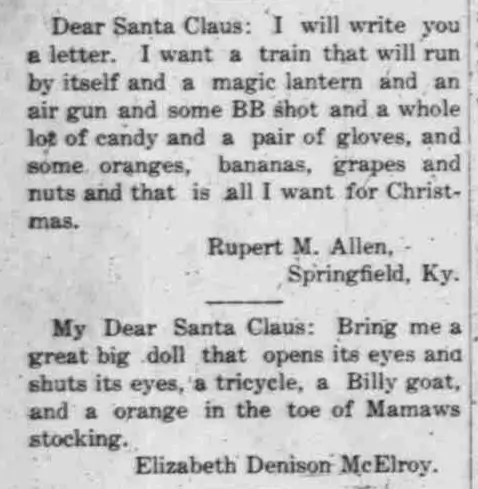
On December 14, 1904, the Springfield Sun of Springfield, Kentucky, printed a batch of children’s letters to Santa Claus. Letter after letter asked for oranges, usually alongside candy and nuts. One child, Elizabeth Denison McElroy, asked for “a great big doll that opens its eyes and shuts its eyes, a tricycle, a Billy goat, and a orange in the toe of Mamaws stocking.”
The paper’s merchants were ready. H. M. O’Nan’s ad announced, in giant type, “A Hanging,” and then, in smaller type, “Up of stockings pretty soon.” Fill them, it said, with “Fresh Candies, Oranges, Nuts, Bananas and Fruits.” Another store in the same issue said Santa Claus would have his headquarters there: “Fill the Stockings Full. I have an abundance of Bananas, Candies, Nuts, Oranges and Fruits.”
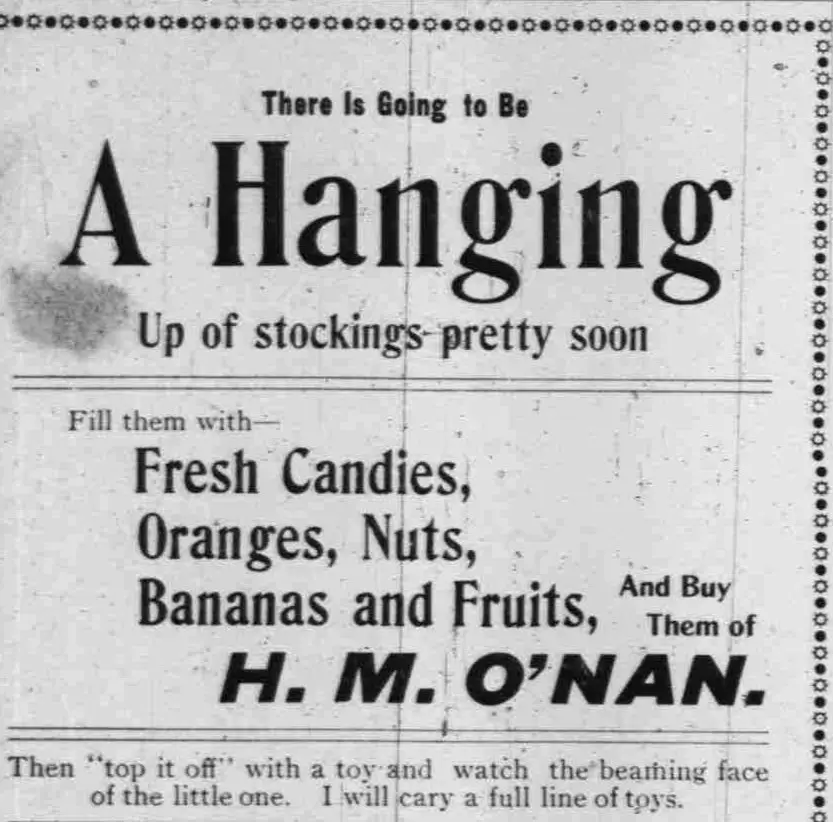
That was four years before Sunkist’s mass marketing began in 1908, as Smithsonian magazine dates it, and twelve years before the ad below.
The 1916 Sunkist ad
On December 20, 1916, the same Sunkist ad ran in The Bismarck Tribune in North Dakota and in the Janesville Daily Gazette and the La Crosse Tribune in Wisconsin, and The Christian Science Monitor ran a version with the same stocking line. In The Bismarck Tribune, under the headline “For Christmas And All Holiday Week,” the California Fruit Growers Exchange, the growers’ cooperative behind the Sunkist brand, said a Christmas table “would not be complete without a generous bowl” of California oranges. Then it told parents: “Put Sunkist oranges in the stockings and keep a liberal supply on hand for the children.”

The ad sold the orange as holiday health food, too. Eating plenty of oranges, it said, “is particularly desirable at holiday time when one is liable to overeat of other foods.” And it pointed readers to the grocers’ ads printed below it: “The retailers whose ads appear below are making a specialty of Sunkist Oranges.” In the Janesville paper that day, one list of Christmas goods read “Mixed Nuts. Sunkist Oranges.”
By 1921, Smithsonian magazine reports, a growers’ trade journal, the California Citrograph, wrote that a stocking “is really not properly filled without an orange in it.” So did a fruit company put the orange in the stocking? The 1904 paper says it was already there. By 1916, Sunkist was advertising a tradition that already existed.
A treat from another time
Sunkist itself told the story of the orange as a rare treat. In December 1927, a California Fruit Growers Exchange ad in several Southern California papers, among them the Covina Argus and the Upland News, said that “a comparatively few years ago oranges were considered a luxury to be afforded by the well-to-do on special occasions.” The orange, it said, had been “making friends fast since the days when it entered the home only to put a bulge in the Christmas stocking or grace the table at the family reunion.” The ad named “the greatest single reason” for the change: “the 20 years of effective educational advertising sponsored by the California Fruit Growers Exchange.”
Others told it as memory. In 1938, a holiday piece in the Northfield Press, in Massachusetts, looked back: “In those days an orange in the toe was a real treat.” In 1946, a Liberty magazine article on the orange business, “Billion-Dollar Orange Squeeze,” said that “in the old days the orange in a child’s Christmas stocking was usually the only orange the child got throughout the year.” And one man who grew up in the Depression told Cleveland’s Plain Dealer that an orange “was a big thing because you couldn’t afford one during the year,” Smithsonian magazine reported.
Saint Nicholas’s gold
The prettiest explanation comes from the legend of Saint Nicholas, who secretly gave a poor man bags of gold so that his three daughters could marry. In the version the St. Nicholas Center tells, one bag lands in a stocking. The Christmas Book, published in 1978, says that “in some countries, children receive oranges in their stockings to represent the gold.”
That was the earliest mention of the idea we found in print. It’s a lovely story, but the newspapers above show the orange in the toe for decades before it.
Still in the toe in the 1950s and ’60s
The orange stayed put. In 1956, a Christmas editorial in Lancaster Farming, a Pennsylvania farm paper, remembered stockings filled “from an orange in the toe to a candy cane curving out the top,” and an ad in The Upland News, in California’s citrus belt, called navel oranges “a delightful Christmas stocking-filler.” Minnie Pearl’s 1963 book, Minnie Pearl’s Christmas at Grinder’s Switch, remembered how “we’d take our Christmas stockin’ and feel that great big orange in the toe.” And a 1968 book, The Christmas Cupboard, told readers, “You may find a juicy orange in the toe of your Christmas stocking.”
The orange is number one on our list of 30 stocking stuffers from 1960s Christmas mornings, from the candy cane at the top to the toe.
Nuts beside it
In the 1904 letters, children asked for “candy, nuts and oranges” in the same breath, and the stores’ ads listed them together. In 1916, the Janesville list read “Mixed Nuts. Sunkist Oranges.” And in a 1978 collection of memories, a red mesh stocking came “filled with candies, nuts and raisins, and an orange.”
Common questions
Did Sunkist start the orange in the Christmas stocking?
Not by the evidence we found. Kentucky children were asking Santa for oranges in 1904, and a local grocer was telling parents to fill stockings with oranges and nuts, four years before Sunkist’s mass marketing began. By 1916, Sunkist ads were telling parents to put its oranges in the stockings: it was advertising a tradition that already existed.
Does the orange stand for Saint Nicholas’s gold?
That’s one explanation you’ll hear. The earliest mention we found in print is a 1978 book, The Christmas Book, which says that “in some countries, children receive oranges in their stockings to represent the gold.” The orange was in the toe long before that.
Why was an orange such a treat?
Papers and memories describe it as something that didn’t come often. In 1946, Liberty magazine said the stocking orange “was usually the only orange the child got throughout the year,” and a man who grew up in the Depression said an orange “was a big thing because you couldn’t afford one during the year.” Even a 1927 Sunkist ad looked back to days when oranges were “a luxury to be afforded by the well-to-do on special occasions.”
What was in the toe of your stocking, and what year was it? Tell us in the comments on the video.
Keep the memories going
Sources and further reading
- Springfield Sun (Springfield, Ky.), Dec. 14, 1904, pages 1, 3 and 4 (Kentucky Digital Newspaper Program, University of Kentucky Libraries, via Internet Archive)
- The Bismarck Tribune, Dec. 20, 1916, page 3 (Library of Congress, Chronicling America)
- Janesville Daily Gazette, La Crosse Tribune and The Christian Science Monitor, Dec. 20, 1916
- Jackie Mansky, Smithsonian: Why We Should Bring Back the Tradition of the Christmas Orange (2018)
- California Fruit Growers Exchange ad: Covina Argus and Upland News, Dec. 16, 1927
- Northfield Press (Northfield, Mass.), Dec. 9, 1938
- Dickson Hartwell, “Billion-Dollar Orange Squeeze,” Liberty, Sept. 7, 1946; reprinted in America: An Illustrated Diary of Its Most Exciting Years (1973)
- St. Nicholas Center: Three Impoverished Maidens
- Robert Joseph, The Christmas Book (1978)
- Lancaster Farming, Dec. 21, 1956
- The Upland News, Dec. 20, 1956
- Minnie Pearl’s Christmas at Grinder’s Switch (1963)
- The Christmas Cupboard (1968)
- See You in September (1978)
Historical details checked October 2026. “Earliest we found” means earliest in our searches of digitized newspapers and books; an older mention may exist.