
Lift the lid on a Christmas candy tin, and you know what’s coming. Wax paper between the layers. Fudge cut into squares. A few white puffs of divinity. And near the bottom, jagged pieces of peanut brittle.
What is old-fashioned Christmas candy? It’s the candy families cooked or mixed at home for the holidays: peanut brittle, divinity, fudge, caramels, toffee, buckeyes, potato candy, popcorn balls and more. Some took a candy thermometer and a strong arm. Others needed no oven at all. Food writer Robyn Stone sums up the Southern version as “a platter or tin full of homemade candy sitting on the counter.” Below are 40 of them, with what each one is and where it turns up in the record.
Watch the companion video
Our video 40 Christmas Candies Our Grandmas Made That Nobody Makes Anymore counts all 40 down, from peanut brittle to Christmas popcorn balls.
40 old-fashioned Christmas candies at a glance
The list follows the countdown in the video, from number 40 to number 1. “No oven” means the candy isn’t baked; some of these still start in a saucepan.
| # | Candy | What it is | How it’s made |
|---|---|---|---|
| 40 | Peanut brittle | Thin, glassy sugar candy full of peanuts | Cooked to hard crack |
| 39 | Divinity | White, airy mounds of beaten egg white and sugar syrup | Cooked syrup, beaten |
| 38 | Penuche | Fudge made with brown sugar instead of chocolate | Cooked to soft ball, beaten |
| 37 | Chocolate fudge, two ways | Beaten by hand, or the marshmallow-cream shortcut | Cooked |
| 36 | Haystacks | Chow mein noodles coated in melted butterscotch chips | No oven |
| 35 | Martha Washington candy | Coconut-pecan centers dipped in chocolate | No oven |
| 34 | Buckeyes | Peanut butter balls dipped in chocolate, a little peanut butter left showing | No oven |
| 33 | Potato candy | Mashed potato and powdered sugar rolled around peanut butter | No oven |
| 32 | Caramels, wrapped by hand | Chewy squares, each wrapped in wax paper | Cooked |
| 31 | Pecan pralines | Creamy Southern rounds of sugar candy packed with pecans | Cooked |
| 30 | Hard tack candy | Glassy pieces, cinnamon or peppermint, dusted in powdered sugar | Cooked to hard crack |
| 29 | Church window candy | A chocolate log full of colored marshmallows, sliced | No oven |
| 28 | Date nut roll | A cooked candy log of dates and nuts, sliced into rounds | Cooked |
| 27 | Chocolate-covered cherries | A whole cherry in fondant and chocolate; the center turns liquid | Dipped, then left to wait |
| 26 | Cream cheese mints | Pastel mints pressed in flower molds | No oven |
| 25 | English toffee | Butter and sugar cooked to amber, topped with chocolate and nuts | Cooked |
| 24 | Needhams | Maine’s potato-and-coconut squares dipped in chocolate | No oven |
| 23 | Peanut butter fudge | Soft, creamy fudge made with peanut butter | Cooked |
| 22 | Coconut creams | Creamy white candy piled with flaky coconut | Cooked |
| 21 | Chocolate peanut clusters | Salted peanuts in melted chocolate | No oven |
| 20 | Bourbon balls and rum balls | Cookie crumbs, cocoa and nuts held together with liquor | No oven |
| 19 | Homemade gumdrops | Chewy pieces, dried and rolled in sugar | Cooked, then dried |
| 18 | Molasses taffy | Molasses candy pulled by hand until golden | Cooked, then pulled |
| 17 | Sponge candy | Crisp candy with a honeycomb inside | Cooked |
| 16 | Caramel pecan logs | A candy center wrapped in caramel and chopped nuts | Cooked |
| 15 | Turtles | Pecans, caramel and chocolate in three layers | Cooked |
| 14 | Butter mints | Small, pale mints that melt in your mouth | No oven |
| 13 | Chocolate peppermint creams | Creamy peppermint centers dipped in chocolate | Dipped |
| 12 | Marzipan fruits | Almond paste shaped and painted like tiny fruit | No oven |
| 11 | Stuffed dates | Dates filled with fondant or a nut, rolled in sugar | No oven |
| 10 | Candied orange peel | Peel simmered in syrup until translucent | Cooked, then dried |
| 9 | Apricot balls | Dried apricots, coconut and condensed milk, rolled in sugar | No oven |
| 8 | Cornflake candy | Cornflakes in a peanut butter syrup, dropped in clusters | Stovetop syrup |
| 7 | Peanut patties | Sugary rounds full of peanuts, often pink | Cooked |
| 6 | Homemade butterscotch | Hard candy made from sugar and butter | Cooked |
| 5 | Sesame brittle | Sicilian giuggiulena: sesame, almonds and honey | Cooked |
| 4 | Torrone | Honey-and-nut nougat pressed between thin wafers | Cooked |
| 3 | Chocolate truffles | Chilled chocolate and cream, rolled in cocoa | No oven |
| 2 | Maple sugar candy | Maple syrup set in molds, often leaf-shaped | Cooked |
| 1 | Christmas popcorn balls | Popcorn shaped by hand in a candy syrup | Cooked syrup |
Want to make some of these? Our cookbook, Christmas at The Recipe Counter, has 100 old-fashioned holiday recipes, including peanut brittle, divinity, penuche and popcorn balls.
1. Brittles, hard candy and taffy
Peanut brittle (#40)
Sugar and syrup go into a pot and cook to the hard-crack stage, about 300 degrees. In go the peanuts, then a spoonful of baking soda. A University of Arkansas extension agent explains that the soda makes the hot mixture foam, and the tiny bubbles give the brittle its light crunch. It’s an old favorite: the Library of Congress points to a 1936 newspaper article that called peanut brittle and several other recipes easy and child-friendly.
Hard tack candy (#30)
Sugar and corn syrup are cooked to about 300 degrees, flavored with a few drops of oil, poured onto a sheet pan, broken into pieces and tossed in powdered sugar. Cinnamon is one choice; peppermint is another. Some families call it hard tack and some call it rock candy, and Appalachian writer Tipper, of Blind Pig and the Acorn, describes it as candy that’s poured, broken and given away at Christmas.
Sponge candy (#17)
Break a piece open and the inside looks like a honeycomb. It starts as a sugar syrup; then the baking soda goes in and it foams up fast, so it needs a big pan. The Library of Congress notes a newspaper recipe for it from 1959. Some people dip the pieces in chocolate, and in some places the same kind of candy is called sea foam.
Homemade butterscotch (#6)
Old-fashioned butterscotch is a hard candy made from sugar and butter. Alice Bradley’s Candy Cook Book (1917) puts it in the chapter on hard candies: one version is poured into a buttered pan and marked in squares. Her butterscotch wafers are dropped from the tip of a spoon instead.
Molasses taffy (#18)
Molasses and sugar are cooked down and poured onto a buttered platter. Once it can be handled, you butter your hands and pull. As you stretch and fold it, the dark candy turns lighter, until it’s a golden rope that gets twisted and cut. In December 1960, American Home magazine called its version Golden Taffy Nuggets, flavored with molasses and pulled until it turned a tawny gold. A 1915 children’s book, When Mother Lets Us Make Candy, says it’s sometimes easier, and always more fun, to let two or more people pull.
Maple sugar candy (#2)
Little leaves of maple sugar that melt on your tongue. The Massachusetts Maple Producers Association describes the method: boil pure maple syrup without stirring, cool it a few minutes, then stir until it loses its gloss and pour it into molds. Yankee magazine calls it an old-fashioned New England treat, and its list of what to leave out for Santa names maple sugar candy for New Hampshire.
Christmas popcorn balls (#1)
Hot candy syrup is poured over a big pan of popped corn and stirred in. Once it’s cool enough to handle, you butter your hands and shape the balls. For Christmas, the syrup can be tinted red or green with a few drops of food coloring, and each ball wrapped in wax paper or plastic. Recipes still get passed along online, and some cooks say they learned theirs from their mothers.
2. Divinity, fudge and other creamy candies
Divinity (#39)
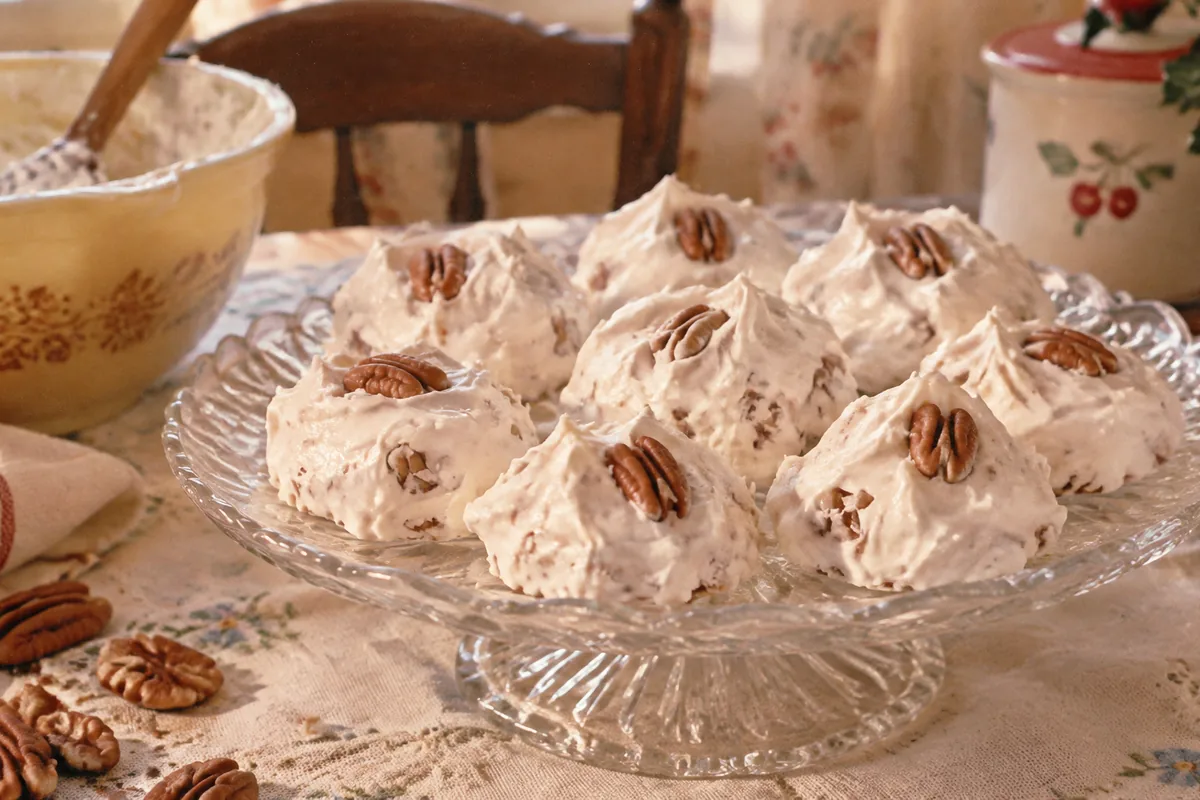
Little white mounds, soft and airy, sometimes with a pecan half on top. Hot sugar syrup is beaten into egg whites until the mixture thickens, then spooned onto wax paper. Candy makers warn that divinity can be finicky on a humid day and may not set, so some cooks picked a dry day before they started. The Library of Congress notes a 1961 newspaper item, “Holiday Candies Are Fun to Make,” with instructions for Christmas Divinity. Our old-fashioned divinity recipe is free on this site, with tips for humid days.
Penuche (#38)
Penuche is fudge made with brown sugar instead of chocolate, cooked to the soft-ball stage and then beaten. It comes out tan. The same 1961 newspaper item included a recipe for Filbert Penuche. Filberts, the University of Missouri Extension notes, are another name for hazelnuts.
Chocolate fudge, two ways (#37)
The old-fashioned way was sugar, milk and chocolate cooked to the soft-ball stage, cooled, and beaten by hand until it went from glossy to thick. The shortcut used marshmallow cream. One shortcut recipe carries a First Lady’s name: the Library of Congress notes that a newspaper ran Mamie Eisenhower’s Million Dollar Fudge in 1956, and the Eisenhower Presidential Library still publishes the recipe, made with marshmallow cream, evaporated milk, two kinds of chocolate and two cups of nuts. It says the fudge is better the second day, and it ends by telling you to store it in a tin box. Read the story and a complete version of Mamie’s fudge.
Peanut butter fudge (#23)
Some families boiled sugar and milk to the soft-ball stage and stirred in the peanut butter at the end; others used a shortcut. It has been on holiday candy pages for a long time: the Library of Congress notes a December 1953 newspaper feature, “Candy and Candy Making,” with recipes for peanut butter fudge and something called Kris Kringle Balls.
Pecan pralines (#31)
In the South, a praline is a creamy round of sugar candy packed with pecans. You cook the sugar, cream and butter, add the pecans, stir just until it starts to thicken, and drop spoonfuls onto parchment before the pot sets. Robyn Stone counts creamy Southern pralines among the candies her grandmother made every December.
Peanut patties (#7)
Sugary rounds full of peanuts, and not brittle. Sugar, corn syrup and raw peanuts are cooked, stirred until thick and spooned out in rounds, and many are colored pink. One home cook, Sheryl of Lady Behind the Curtain, shares her grandmother’s recipe under another name: peanut rounders.
Coconut creams (#22)
In December 1960, American Home ran a spread of homemade Christmas candies. One was White Velvet Coconut Creams, “white velvet creams piled high with flaky coconut.” The same spread had Christmas sugar mints decorated with red poinsettias and a chocolate cream fudge made crunchy with Brazil nuts.
3. Caramels and toffee
Caramels, wrapped by hand (#32)
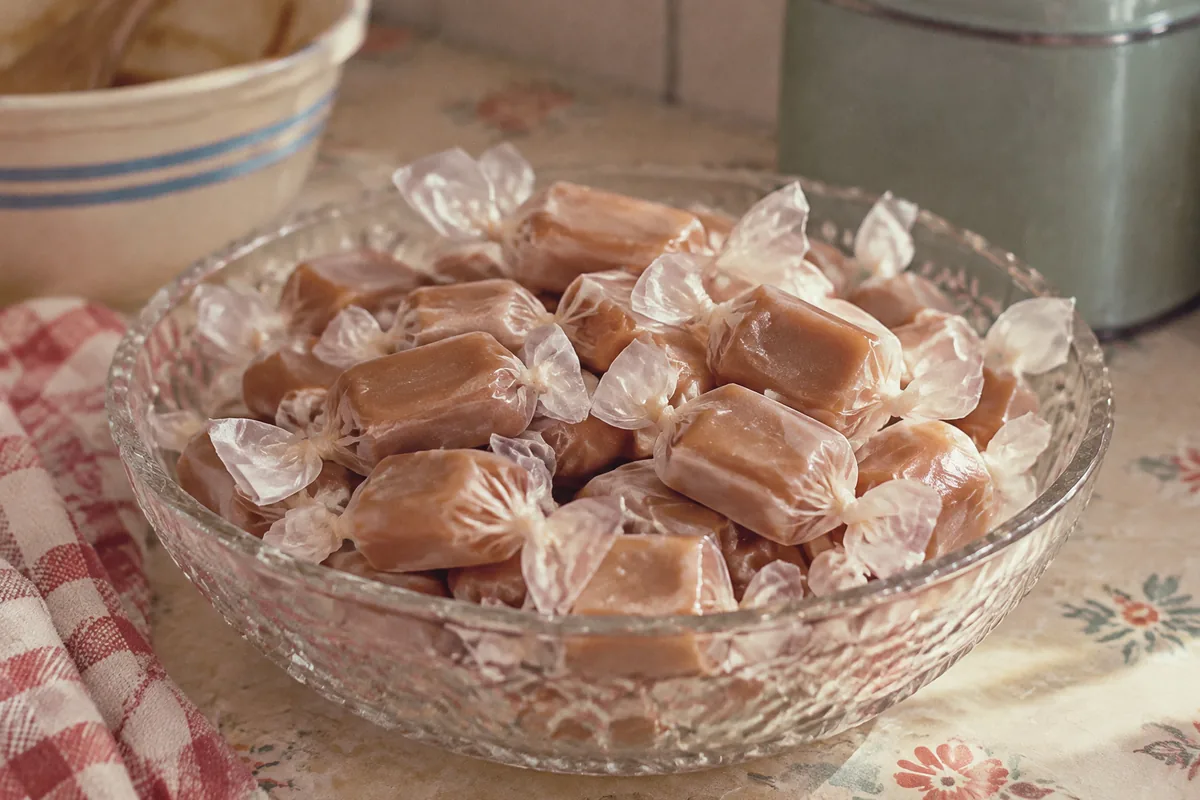
Cooking caramels took patience; wrapping them took extra hands. Writing for King Arthur Baking in 2014, Barb Alpern described the caramels her mother made every year during the holidays. Her mother grew up on a farm where caramels were a handmade gift, read Little Women aloud to the children while she stirred, and then had them help wrap the candy at the kitchen table, with a warning to “watch the profits.” Each piece gets its own wrapper of wax paper.
English toffee (#25)
Butter and sugar are cooked until they turn a dark amber, poured into a pan, and covered with melted chocolate and chopped nuts. Once it cools, you break it into crisp pieces. Robyn Stone lists her grandmother’s toffee among the candies made every December. And sometimes the names got mixed up: Katy Keck has written that her grandmother called her Christmas toffee butterscotch.
Caramel pecan logs (#16)
Slice one and you see the layers: a candy center, a wrap of caramel, and an outside crusted with chopped nuts. Land O’Lakes describes the method: shape the center into a log, coat it in warm caramel, roll it in nuts, chill it and slice it. Wrapped up, a whole log makes a holiday gift.
Turtles (#15)
Three layers: pecans, caramel and chocolate. At home, you’d set little mounds of pecan halves in paper liners, spoon caramel over each one and finish with melted chocolate. Home cook Sue Ringsdorf remembers her mother making turtles at Christmas time.
Date nut roll (#28)
A cooked candy full of chopped dates and nuts, rolled into a log and sliced into rounds. Robyn Stone writes that her grandmother, Verdie, would spend a day in the kitchen making candy every Christmas, testing it by dropping bits into a bowl of water, and that date nut roll was her daddy’s favorite Christmas candy.
4. No-bake Christmas candies
None of these go in the oven. A few still use the stovetop to melt chocolate or warm a syrup.
Buckeyes (#34)
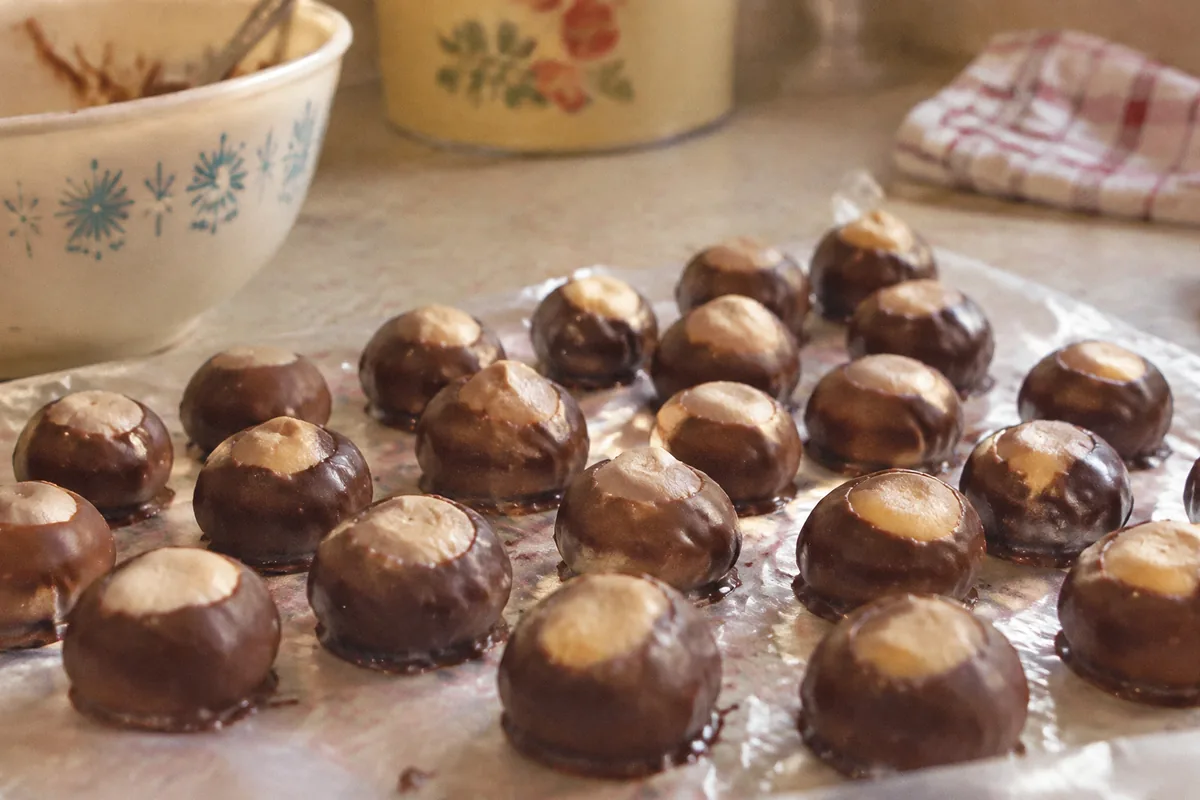
Peanut butter balls dipped in chocolate on a toothpick, with a small part left bare so each one looks like the nut of the Ohio buckeye tree. In a 1983 Arizona Republic column, later posted online by her son, Gail Tabor wrote that it began at Christmas in 1964, when her mother gave her a recipe for chocolate-covered peanut butter candy, and that the first ball she dipped wasn’t fully covered. Peanut butter and chocolate candy was around long before that, though; Hershey’s archives date H.B. Reese’s peanut butter cups to around 1928.
Potato candy (#33)
Slice into it and you see a spiral of white candy rolled around a stripe of peanut butter. The white part is mashed potato mixed with enough powdered sugar to make a dough you can roll out. It’s spread with peanut butter, rolled up, chilled and sliced into pinwheels. Potato candy is a Christmas favorite in Appalachia, and True Treats, a historic candy shop, calls its origin a mystery. We go into both potato candies in Potato Candy: Appalachian Pinwheels and Maine Needhams.
Needhams (#24)
Maine’s potato candy looks nothing like the pinwheels. A needham is a square of coconut candy covered in chocolate, with mashed potato in the filling. According to the New England Historical Society, some Mainers find needhams in their Christmas stockings, and in 1986 the Maine writer John Gould called the candy “sacred and peculiar” to Maine.
Haystacks (#36)
Little messy piles that look like their name. You melt butterscotch chips, sometimes with peanut butter, stir in crunchy chow mein noodles, and drop clusters onto wax paper to set. With no oven and no candy thermometer, they’re one kids can help shape, and in some families they were a regular on the Christmas cookie tray.
Martha Washington candy (#35)
A plain chocolate ball on the outside; inside, coconut and chopped pecans held together with sweetened condensed milk and powdered sugar. The name sounds historic, but Taste of Home notes that the candy’s origins are murky. In the University of Texas System’s 2017 holiday cookbook, Deborah Tanner shared her family’s version and wrote that her mother, Joann Perry, made it every Christmas.
Church window candy (#29)
From the outside, a plain chocolate log. Slice it, and each round shows colored marshmallows, pink, green, yellow and orange, like little stained-glass windows. Melted chocolate and butter are stirred together with the marshmallows, shaped into a log, sometimes rolled in coconut, and chilled until firm. Some people call them church window cookies, even though nothing gets baked.
Cream cheese mints (#26)
Cream cheese, powdered sugar, mint flavoring and food coloring, mixed into a soft dough, pressed into flower molds and left to firm up. They’re usually pastel and are a familiar sight at showers and weddings, but some versions dress them up in red, green and white for Christmas.
Butter mints (#14)
Small, pale pieces that melt in your mouth. Some versions never touch the stove: Land O’Lakes beats butter with powdered sugar, half-and-half and peppermint extract into a soft dough, then lets the pieces sit out for several hours until the outside dries. Writing in The Bitter Southerner, Christine Rucker says it isn’t a proper Southern Christmas without them.
Bourbon balls and rum balls (#20)
Crushed vanilla wafers, cocoa, powdered sugar, chopped nuts and a little corn syrup, held together with bourbon or rum, rolled into balls and coated in sugar. The liquor isn’t cooked off, so they were meant to stay out of the kids’ reach. In Kentucky, the Rebecca-Ruth candy company says Ruth Booe invented its chocolate-covered bourbon ball in 1938, and a Kentucky historical marker credits her with it. The homemade kind is a different candy.
Chocolate peanut clusters (#21)
Melt the chocolate, stir in salted peanuts, drop spoonfuls onto wax paper and let them set. It’s the kind of candy a kid can help mix up. Katy Keck remembers chocolate salted-peanut clusters among her grandmother’s Christmas candies, and the 1961 newspaper item had Walnut Clusters, too.
Cornflake candy (#8)
Breakfast cereal turned into Christmas candy. You warm sugar and corn syrup just until the sugar melts, stir in peanut butter, then the cornflakes, and drop clusters onto wax paper before they set. Southern Living says Southerners love to make the clusters during the holiday season.
Apricot balls (#9)
Chopped dried apricots mixed with coconut and sweetened condensed milk, rolled into little balls and coated in sugar. Katy Keck names apricot balls among her grandmother’s Christmas candies, along with the toffee, the divinity and the peanut clusters.
Chocolate truffles (#3)
Simpler than they look. Hot cream is poured over chopped chocolate and stirred smooth; once it firms up, it’s shaped into balls and rolled in cocoa or finely chopped nuts. The name comes from how they look: little knobby balls, like the truffles dug from the ground.
5. Fruit, filled and dipped candies
Chocolate-covered cherries (#27)
A whole cherry inside a chocolate shell, with a liquid center. Each cherry is coated in fondant, then chocolate, and then the cherries sit for several days. Retail Confectioners International explains that, given time, the fondant around the cherry turns liquid inside the chocolate. The hardest part is leaving them alone.
Chocolate peppermint creams (#13)
A creamy peppermint center, shaped into rounds, firmed up and dipped in chocolate. It’s an old family of candy: Alice Bradley’s 1917 Candy Cook Book describes creamy fondant centers dipped in melted chocolate, with peppermint among the centers.
Stuffed dates (#11)
Split a date open like a tiny candy box, tuck in fondant or a nut, press it closed and roll it in sugar. Bradley’s 1917 book includes Date Creams, and A Little Candy Book for a Little Girl (1918), in which a mother teaches her daughter, Betsey, to make candy, has stuffed dates too.
Marzipan fruits (#12)
Tiny strawberries, apples and pears made of almond paste, shaped by hand and colored. The December 1960 American Home spread included almond-paste Sugarplum Strawberries, which it described as crimson and plump, with a delicate almond flavor. Some cooks poke tiny holes in each strawberry with a toothpick to look like seeds.
Candied orange peel (#10)
The part of the orange you’d normally throw away. Strips of peel are simmered in fresh water a few times to take out the bitterness, cooked in sugar syrup until translucent, then dried and rolled in sugar or dipped in chocolate. One family blogger, Leslee of Chic Ideology, calls it a holiday recipe handed down from the blogger’s great-grandmother.
Homemade gumdrops (#19)
A sweet, flavored mixture sets up in a pan and is cut into pieces. Then comes the part that takes patience: letting the pieces dry. Recipes differ on whether that comes before or after they’re rolled in sugar. Made in red and green, they’re little jewels for the top of the candy plate, sugary outside and softer than the ones in a bag.
6. Candies from family traditions
Sesame brittle (#5)
Not every family’s tin looked the same. In Aureleo Rosano’s Italian-American family, one of the Christmastime treats was giuggiulena, a Sicilian brittle of sesame seeds, almonds and honey. The honey and sugar are cooked, the seeds and nuts stirred in, and the mixture is poured out, rolled flat and cut into small pieces.
Torrone (#4)
A chewy honey-and-nut nougat, packed with almonds or other nuts and pressed between thin wafers. The Italian cooking show Ciao Italia calls it a symbol of the Italian Christmas season. Depending on the recipe and how long it cooks, torrone can come out soft and chewy or much firmer.
Common questions
Which old-fashioned Christmas candies need only a few ingredients?
Several on this list. Cream cheese mints take cream cheese, powdered sugar, mint flavoring and food coloring. Potato candy pinwheels take a small potato, powdered sugar and peanut butter. Chocolate peanut clusters are melted chocolate and peanuts. Robyn Stone’s list of her grandmother’s Christmas candies is titled for recipes of seven ingredients or less.
Where did buckeye candy come from?
Gail Tabor wrote in a 1983 newspaper column that her buckeyes began with a candy recipe her mother gave her at Christmas in 1964, and Experience Columbus says she is widely credited with creating the candy in 1964. Chocolate-history writer Deborah Prinz retold Tabor’s claim in 2015. Peanut butter and chocolate candy is older: Hershey’s archives date H.B. Reese’s peanut butter cups to around 1928. The candy is named for the nut of the Ohio buckeye tree.
What is potato candy made of?
Plain mashed potato and a lot of powdered sugar. In Appalachian pinwheels, that dough is rolled around peanut butter; in Maine’s needhams, it’s mixed with coconut and dipped in chocolate. Our potato candy guide covers both.
Which piece did you always grab first from the tin? Tell us in the comments on the video.
Keep the memories going
- 1960s Christmas candy: 25 store-bought favorites
- 1960s Thanksgiving desserts: 27 pies, puddings and treats
- Potato candy: Appalachian pinwheels and Maine needhams
- How to make an old-fashioned Christmas candy box
- Old-fashioned divinity recipe, with tips for humid days
- 21 dime store candies from the 1960s, and which ones still exist
- For candy bars and penny candy all year, see our candy cookbook, Penny Candy to Candy Bars.
Sources and further reading
- Eisenhower Presidential Library: Mamie’s Million Dollar Fudge (recipe sheet)
- Alice Bradley, The Candy Cook Book (Boston: Little, Brown, 1917), Internet Archive
- Elizabeth and Louise Bache, When Mother Lets Us Make Candy (1915), Internet Archive
- Amy L. Waterman, A Little Candy Book for a Little Girl (1918), Project Gutenberg
- Rachel Gordon, “Cooking Up History: Candy Recipes for the Holidays,” Library of Congress, Dec. 14, 2022
- Click Americana: American Home magazine’s Christmas candy pages, December 1960
- Kentucky Historical Society: Ruth Hanly Booe (1891–1973), Kentucky Historical Marker 2192; Rebecca-Ruth Candy: Our History
- Hershey Community Archives: H.B. Reese and the Reese Candy Company
- Gail Tabor’s 1983 column, posted as “The origin of Buckeye balls,” 2012
- Deborah Prinz, “Bringing Buckeye Candy to Experts,” On the Chocolate Trail, 2015
- Experience Columbus: The History of the Buckeye Candy in Columbus
- New England Historical Society: Needham, Potato Candy Sacred and Peculiar to Maine
- University of Arkansas Cooperative Extension: Holiday Candy Making, When Sweet Treats Become Science
- University of Missouri Extension: Nut with two names
- Massachusetts Maple Producers Association: Making candy and cream
- Retail Confectioners International: Two Methods for Making Cordial Cherries
- Robyn Stone, “Christmas Candies My Southern Grandmother Made,” Add a Pinch
- Barb Alpern, “Mom’s Caramels,” King Arthur Baking, Dec. 10, 2014
- Katy Keck, “English Toffee aka Grandmother’s Butterscotch,” Dec. 19, 2016
- Aureleo Rosano, “Giuggiulena: Sicilian Sesame Brittle,” 2014
- Tipper, “Christmas – Hard Rock Candy,” Blind Pig and the Acorn, Dec. 9, 2013; “Potato Candy”
- True Treats Candy: The Ever-Mysterious Christmas Potato Candy
- Taste of Home: Martha Washington Candy
- University of Texas System, Living Well Family Cookbook, Holiday 2017
- Christine Rucker, “Mrs. Putnam’s Butter Mints,” The Bitter Southerner, 2018
- Yankee: Maple Candy, An Old-Fashioned Treat; Yankee: What to Leave for Santa in New England
- Ciao Italia: Torrone; Land O’Lakes: Caramel Nut Logs and Buttermint Twists; Southern Living: Old-Fashioned Cornflake Candy
- House of Nash Eats: Old Fashioned Divinity Candy; SueBee Homemaker: Homemade Turtle Candy; Chic Ideology: Candied Orange Peel; Lady Behind the Curtain: Grandma’s Homemade Peanut Rounders
Recipe and method sources
- Exploratorium: Candy-making Stages; Hill Country Chocolate: The Definitive Guide to Peanut Brittle; Hill Country Chocolate: fudge mistakes
- Katie Reed, A Mother Thing: Hard Tack Candy (A Christmas Tradition); Heart’s Content Farmhouse: Cinnamon Rock Candy and Old-Fashioned Butterscotch Hard Candy
- The Novice Chef: Sponge Candy; Tasting Table: maple syrup candy; Tasting Table: storing homemade candies
- Cooks.com: Christmas Popcorn Balls; Southern Food and Fun: Christmas Popcorn Balls
- Add a Pinch: divinity; Deep South Dish: Never Fail Divinity; Grand Forks Herald: Grandma’s penoche, Mom’s divinity; The Nibble: Penuche; Audrey’s Little Farm: Old Fashioned Peanut Butter Fudge
- Once Upon a Chef: Pecan Pralines; Garden & Gun: Pecan Pralines; Texas Cooking: Peanut Patties
- Bigger Bolder Baking: Classic English Toffee
- Nestlé Toll House: Butterscotch Haystacks; The Irish Mother: Butterscotch Haystacks; Barefeet in the Kitchen: Haystacks
- These Old Cookbooks: Church Windows Candy; Cooking With Carlee: Church Window Cookies
- Sugar Spun Run: Cream Cheese Mints; Together As Family: Christmas Cream Cheese Mints
- Food.com: Christmas Rum Balls (or Bourbon Balls); Sally’s Baking Addiction: Rum Balls
- Taste of Home: Peanut Clusters, Goody-Goody Gumdrops, Perfect Peppermint Patties and Apricot Coconut Balls; Food.com: Apricot Balls
- Food Network: Chocolate Truffles; Sporked: Why is it called a truffle?
- Supper in the Suburbs: Homemade Marzipan Fruits; The Mediterranean Dish: Candied Orange Peel; MasterClass: Torrone
Historical details checked November 4, 2026.