In December 1969, a Hickory Farms ad in House and Garden showed its famous Beef Stick packed in a box with five kinds of cheese, for $7.98. Three years earlier, Kann’s in Washington had sold three pounds of Gay Nineties Danish Cookies in an attractive tin, as the page put it, with a gift mailer to send them in, for $3.
What food gifts did the stores sell at Christmas in the 1960s? The big stores’ Christmas books and the mail-order houses sold cheese in boxes, crocks and brandy snifters; fruitcakes, from bite-size miniatures to cakes from Texas; tins of cookies, pretzels and glacé fruit; imported foods packed in a shoe-shine kit or a wooden crate; and fruit, steaks and candy by mail. Hickory Farms sold its Beef Stick and cheese in its own stores, and Civitan clubs sold Claxton fruitcake. The catalogs and ads show what was for sale; they can’t tell us how many families bought it. Here are forty 1960s Christmas food gifts, each with the store, catalog or seller, the year and, for all but one, the price on the page.
Watch the companion video
Our companion video counts all 40 down, from a candy house you built yourself to the Hickory Farms box. The top ten start at 19:10.
1960s Christmas food gifts at a glance: all 40
The list follows the countdown in the video, from number 40 to number 1. Each price is the one printed on the page, with the store’s Christmas catalog or the magazine ad or column that printed it and the year. “Still sold?” shows the ones we found still sold on the maker’s own site in November 2026; a dash means we make no such claim.
| # | Gift | Store or seller, and year | Printed price | Still sold? |
|---|---|---|---|---|
| 40 | Enchanted Candy House | Sears Christmas Book, 1961 | $1.99 | — |
| 39 | Mini Bachi stove with cocktail sausages | Sears Christmas Book, 1960 | $5.97 | — |
| 38 | Reese’s fish-shaped cheese board | Kann’s catalog, 1965 | $3 | — |
| 37 | Crock of Gold cheese spread | Sears Christmas Book, 1961 | $3.99 | — |
| 36 | Petits fours, box of 40 | Sears Christmas Book, 1961 | $2.67 | — |
| 35 | Ceramic beehive of honey | Sears Christmas Book, 1961 | $1.87 | — |
| 34 | Cresca’s The Toast party pack | Woodward and Lothrop catalog, 1963 | $5 | — |
| 33 | Pennsylvania Pretzel Pack | Sears Christmas Book, 1961 | $4.99 | The pack: —. Sturgis pretzels: yes, the family says |
| 32 | Claxton fruitcake | Civitan clubs (Belle Glade Herald ad, 1963) | No price in the ad | Yes: Claxton Bakery’s site |
| 31 | Cheese in four brandy snifters | Woodward and Lothrop catalog, 1963 | $4.25 | — |
| 30 | Nine imported teas | Sears Christmas Book, 1960 | $1.97 | — |
| 29 | Wooden shoes filled with chocolates | Woodward and Lothrop catalog, 1963 | $3 a pair | — |
| 28 | Salad Splendor dressings | Kann’s catalog, 1965 | $3 | — |
| 27 | Apothecary spice rack, 12 jars | Sears Christmas Book, 1961 | $7.99 | — |
| 26 | Vermont maple syrup, quart tin | Sears Christmas Book, 1960 | $1.97 | — |
| 25 | Texas red grapefruit, half bushel | Pittman and Davis (House and Garden, Dec. 1969) | $6.90 | — |
| 24 | Strawberry Bucket | Sears Christmas catalog, 1966 | $4.99 | — |
| 23 | Globe Book Ends | Kann’s catalog, 1968 | $13.95 | — |
| 22 | Mr. Snowman candy jar | Woodward and Lothrop catalog, 1963 | $1 | — |
| 21 | Dips ‘n Sticks | Sears Christmas Book, 1960 | $2.97 | — |
| 20 | Constant Comment tea, 2 ounces | Woodward and Lothrop catalog, 1963 | 90 cents | Yes: Bigelow still makes it |
| 19 | Cheese and jelly set with china dishes | Sears Christmas Book, 1961 | $2.87 | — |
| 18 | Sundae topping set | Kann’s catalog, 1968 | $7.95 | — |
| 17 | Cordial-ettes | Sears Christmas catalog, 1966 | $2.99 | — |
| 16 | Old Mill jellies, three jars | Woodward and Lothrop catalog, 1963 | $1.15 | — |
| 15 | Mrs. Carver’s fruitcake miniatures, 42 | Kann’s catalog, 1965 | $9 | — |
| 14 | Bissinger’s Nut Balls, one pound | Bissinger’s (House and Garden, Dec. 1965) | $4.50 | Bissinger’s: yes, sells chocolates online and in St. Louis |
| 13 | Ham Buffet | Kann’s catalog, 1966 | $7.50 | — |
| 12 | Dobosh torte | Sears Christmas catalog, 1966 | $2.99 | — |
| 11 | Glacé fruit, two pounds | Sears Christmas Book, 1960 | $2.97 | — |
| 10 | Shoe-shine kit of imported foods | Sears Christmas Book, 1960 | $6.97 | — |
| 9 | Omaha Steaks in a picnic cooler | Omaha Steaks (House and Garden, Dec. 1965) | $24.75 | — |
| 8 | Treasure of Treats | Mission Pak (House and Garden, Nov. 1960) | $8.69 | — |
| 7 | DeLuxe fruitcake, two pounds | Collin Street Bakery (House and Garden, Nov. 1960) | $4.15 | Yes: Collin Street’s site |
| 6 | Foods of the World crate | Sears Christmas catalog, 1966 | $8.99 | — |
| 5 | Fruit-of-the-Month Club, 12 boxes | Harry and David (House and Garden, Dec. 1960) | $53.95 | — |
| 4 | Party Pack, two pounds | The Swiss Colony (House and Garden, Nov. 1960) | $4.10 | The Swiss Colony: yes, ships Christmas food gifts |
| 3 | Gay Nineties Danish Cookies, tin | Kann’s catalog, 1966 | $3 | — |
| 2 | Royal Riviera pears, 10 to 14 | Harry and David (House and Garden, Dec. 1960) | $4.35 | Tower of Treats: yes, Harry and David says |
| 1 | Beef Stick and cheese, the Texas Spread | Hickory Farms (House and Garden, Dec. 1969) | $7.98 | Hickory Farms: yes. Beef Stick: renamed, Hickory Farms says |
1. From the Sears Christmas Books
Sears’ Christmas Book went back to 1933. That first book, the Harvey County Historical Museum says, ran 87 pages, and it already offered fruitcake. In 1968, Sears renamed the book the Wish Book, and in 1993 it stopped printing its big Christmas catalog. In 1961, Sears put food gifts on a page headed “Delicacies, sweets and munching treats.” For more gifts from the big stores’ Christmas books, including the store’s own fruitcake, see our list of 1960s Christmas gifts.
Enchanted Candy House, Sears (#40)
You built this one yourself. Sears’ 1961 Christmas Book sold a cardboard house to cover in candy, with two pounds of it in the box: sugar wafers, candy hearts, spearmint leaves, spice drops, wintergreen lozenges, green sugar and candy cigarettes, plus extra for nibbling while you built. Instructions came with it, and the whole kit was $1.99.
Mini Bachi stove, Sears (#39)
This food gift came with its own stove. Sears’ Mini Bachi of 1960 was a little cast-iron stove with a ten-inch chrome-plated grid and bamboo spears, packed with Danish cocktail sausages, barbecue glaze and spicy cocktail crackers in a decorated mailing carton. It cost $5.97.
Crock of Gold, Sears (#37)
The cheese came in pottery. Sears’ Crock of Gold was an earthenware crock with a tight-fitting lid, brimful with 26 ounces of sharp cheese spread for party canapés. In 1961 it was $3.99.
Petits fours by mail, Sears (#36)
Sears called them French pastries: little frosted cubes, chocolate or pastel, with creamy layers inside. In 1961, a box of 40 was $2.67. Two years later, Woodward and Lothrop sold Hills of Westchester petits fours, 24 for $1.85, and by 1968 Kann’s was selling them as “Confections with the Angel Touch.”
Ceramic beehive of honey, Sears (#35)
For $1.87 in 1961, Sears sent a ceramic hive holding eight ounces of orange blossom honey, with a lid and spoon, in a gift box. When the honey was gone, Sears said, you could refill the hive and serve jams and jellies from it. A ceramic honey bee was $1.77.
Pennsylvania Pretzel Pack, Sears (#33)
Pretzels came by the tin. Sears’ 1961 pack held more than a pound and a half of cheese slims, thins, beers, nutzels and stix, in a tin with an Amish design, for $4.99. Pennsylvania’s claim to the pretzel is an old one: in 1861, Julius Sturgis opened a pretzel bakery in Lititz, Pennsylvania, that the bakery calls the first commercial pretzel bakery in America, and the family says it has baked pretzels ever since.
Nine imported teas, Sears (#30)
One box held a tour of the world’s teas, half an ounce each: English Breakfast, Darjeeling, Keemun, Assam, Rare Jasmine, Lapsang Souchong, Formosa Oolong and more. Sears sold the box of nine for $1.97 in 1960, and $1.99 in 1961.
Apothecary spice rack, Sears (#27)
For the cook, Sears’ 1961 book had a rack of twelve four-inch apothecary jars of spices, among them hickory-smoked celery and onion salts, for $7.99. An eight-jar rack was $5.49.
Vermont maple syrup, Sears (#26)
In 1960, a one-quart tin of pure Vermont maple syrup was $1.97, and the page had ideas beyond pancakes: try it on vanilla ice cream, grapefruit and rhubarb, or blend it with grapefruit juice, prune juice or applesauce.
Strawberry Bucket, Sears (#24)
The preserves came in a little bucket. In 1966, Sears filled a little California redwood bucket, trimmed in brass, with more than two pounds of strawberry preserves, for $4.99.
Dips ‘n Sticks, Sears (#21)
Sears sold this one partly for the glasses. In 1960, two boxes of Italian breadsticks came with three six-ounce King Arthur tumblers of cheese spread, garlic, chives and sharp, for $2.97. The page said you’d be using the tumblers long after the spread was gone.
Cheese and jelly set, Sears (#19)
Four china jelly dishes, each with a flower painted on it, came in Sears’ 1961 cheese and jelly set, with four little glasses of cheese (blue, sharp, rum and Herkimer) and four of jelly (quince, grape, mint and apple). All of it was $2.87, in a gift box with roses on it.
Cordial-ettes, Sears (#17)
Party cakes named for cordials. Sears’ 1966 Christmas catalog sold thirty two-bite Cordial-ettes with chocolate and vanilla icing, filled with flavors like crème de cacao, brandy and rum, for $2.99.
Dobosh torte, Sears (#12)
A bakery layer cake by mail. The 1966 catalog’s Dobosh torte had seven layers of creamy chocolate between eight thin layers of butter-rich cake, iced in dark chocolate, for $2.99. The cake is named for a Budapest baker, József Dobos, who showed it off at an 1885 exhibition in a pavilion staffed by more than 100 people, according to Taste Hungary. In Wisconsin, The Swiss Colony opened its own bakery in 1959, and the company says the first thing made there was a Dobosh torte.
Glacé fruit in a tin, Sears (#11)
Fancy candied fruit came packed in a bright tin you could reuse. Sears’ 1960 assortment held kumquats, little Seckel pears, tangerines, figs, pineapple and cherries, peeled and candied, the page said, by a treasured Old World recipe. Two pounds were $2.97. By 1966, a two-and-a-quarter-pound tin was $4.29.
The shoe-shine kit, Sears (#10)
In 1960, Sears packed German herring, Danish cookies, Norwegian kippers and Japanese tuna spread into a wooden shoe-shine kit, for $6.97.
Foods of the World crate, Sears (#6)
Six years after the shoe-shine kit, imported food came packed like freight. In its 1966 Christmas catalog, Sears sold Foods of the World “just off the ship,” in the original wooden box, complete with a bill of lading. Inside, in real packing straw, were a sliced ham and Camembert from France, dark pumpernickel from Germany, Spanish olives and Italian antipasto, more than three pounds in all, for $8.99.
2. From Woodward and Lothrop and Kann’s
Two Washington department stores supplied 13 of the forty. Washingtonians called Woodward and Lothrop “Woodies,” and by the early 1920s, WETA’s history says, it was the biggest department store south of Philadelphia. It had its own Food Shop, Bake Shop and a Tea Room on the seventh floor, and the DC Preservation League remembers the Tea Room’s waitresses in dark green satin uniforms, white aprons and white nurse shoes. One viewer remembers: “Woodies is a much missed department store.” It closed in 1995. Kann’s had opened in 1893 on Market Space, promising “the best of everything for the least money”; it was sold in 1971 and closed in May 1975.
Reese’s fish cheese board, Kann’s and Woodward and Lothrop (#38)
In 1965, Kann’s sold a fish-shaped cheese board from Reese Finer Foods with eight imported cheeses, and the tail of the fish was the knife. It cost $3. Two years earlier, Woodward and Lothrop had a Reese fish board covered in process cheese for $2.99; its page began, “Happy is the hostess who receives Reese’s Happy Fish cheese board.” On the same Kann’s page, Reese packed 28 imported cheeses into something it called a Cheese Roulette.
The Toast, Woodward and Lothrop (#34)
A party in one package. The store’s 1963 Christmas catalog had a page for its Food Shop, and on it was Cresca’s The Toast: sardines, smoked oysters, caviar and crackers, for $5.
Cheese in brandy snifters, Woodward and Lothrop (#31)
Brandy snifters, filled with cheese instead of brandy. Sue Ann’s set of four small ones was $4.25 at Woodward and Lothrop in 1963, and a single large snifter with three-quarters of a pound of sharp cheese was $3.99.
Wooden shoes from Holland, Woodward and Lothrop (#29)
In 1963, Woodward and Lothrop sold a pair of hand-painted wooden shoes from Holland, filled, as its page said is the tradition, with surprises. Here the surprises were foil-wrapped chocolates, and the pair was $3. The tradition is Sinterklaas: in the Netherlands, children set out their shoes for him, and in the morning they may find chocolate coins and candy inside, the St. Nicholas Center says.
Salad Splendor, Kann’s (#28)
A Christmas gift of salad dressing. In 1965, Kann’s sold Reese Finer Foods’ Salad Splendor: five eight-ounce dressings, creamed garlic, Tropical Fruit, creamed slaw, creamed onion and a tomato marinade, for $3. Reese had its own section of gifts on that Kann’s page.
Globe Book Ends, Kann’s (#23)
The box was the part you kept. In 1968, Kann’s sold Houston Foods’ Globe Book Ends: two old-world globes on walnut-finished wood, and between them a gourmet “library” of tasty delights, for $13.95. For $3.99, the World Traveler packed twelve imported cheese spreads in a box made to look like a suitcase. Houston Foods had a whole section of that page, with an apple board with a cutting tile and knife, jams and jellies served in little jiggers, and a Silent Butler with a removable handle, filled with imported cheese spreads.
Mr. Snowman candy jar, Woodward and Lothrop (#22)
A glass snowman full of candy cost a dollar at Woodward and Lothrop in 1963. When the sweets were gone, the page suggested filling him with flowers or bath powder.
Constant Comment, Woodward and Lothrop (#20)
At the Woodward and Lothrop Food Shop in 1963, two ounces of Constant Comment loose spice tea were 90 cents, and fifty tea bags were $1.95. Ruth Campbell Bigelow created the blend in 1945, mixing black tea with orange rind and sweet spices in her New York kitchen, and named it for what her friends told her: it was a source of constant comment. Bigelow says the third generation of the family runs the company today, and it still makes the blend.
Sundae topping set, Kann’s (#18)
Ice cream toppings as a Christmas gift. In 1968, Kann’s sold a John Wagner and Son parfait set, six eight-ounce sauces and toppings, four parfait glasses and an ice cream scoop, for $7.95.
Old Mill jellies, Woodward and Lothrop (#16)
Small jars for a small price: three little jars of Goodman’s Old Mill jellies and preserves, with flowered lids, were $1.15 in Woodward and Lothrop’s 1963 catalog. Across town, W. Bell and Company’s 1963 catalog had its own “Old Mill” gift packs: a woven basket of seven Floriana preserves and jellies with foil-wrapped candies, listed at $5.95, which the page said would make a wonderful muffin server when it was empty.
Fruitcake miniatures, Kann’s and Woodward and Lothrop (#15)
Fruitcake, bite-size. In 1965, Kann’s sold 42 of Mrs. Carver’s little fruitcakes, with sauce, in a tin, for $9. By 1968, Kann’s page described each of Mrs. Carver’s bite-size miniatures as individually baked, packed in a tin with its own serving tray. Woodward and Lothrop’s 1963 catalog had eighteen miniatures from Hills of Westchester, with hard sauce, for $3.95.
Ham Buffet, Kann’s (#13)
A whole party in one bright box. Houston Foods’ Ham Buffet held a pound of ham, six cheese spreads, cookies from France, Norwegian kipper snacks, smoked clams and sardines. Kann’s sold it for $7.50 in 1966, and again in 1968.
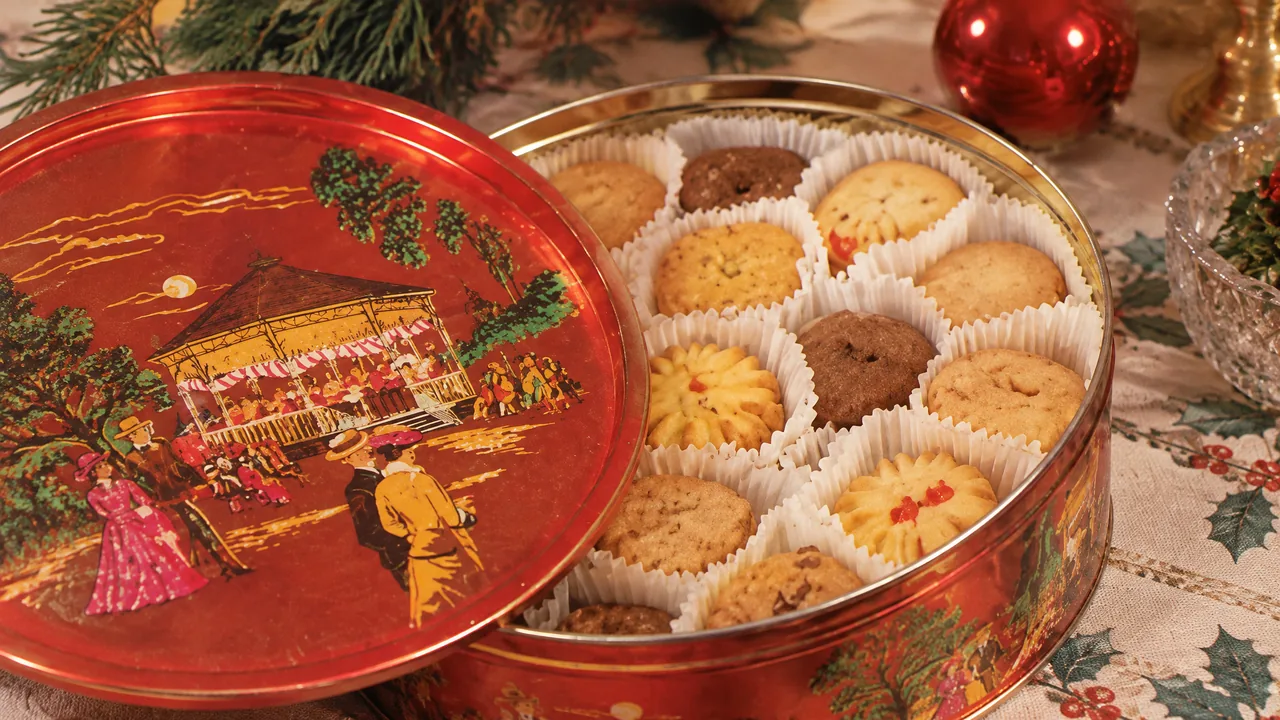
Danish cookie tin, Kann’s (#3)
In 1966, Kann’s sold Gay Nineties Danish Cookies from the Deer Park Baking Company: three pounds for $3, with a gift mailer to send them in. A year earlier, Kann’s had sold Deer Park’s Gay Nineties cookie treats, a full three pounds in a festive tin that doubled as a serving tray, for $2.69.
3. The boss’s Christmas box, 1960
Some Christmas food boxes came from the office. In September 1960, the trade magazine Sales Management published its yearly survey of the executives who chose their companies’ business gifts. Cheese had jumped from ninth place to third among all gifts, and hams led the food gifts, with mentions up 25 percent; Armour came first and Swift second. The cheese company those buyers checked most often was Wisconsin Cheeseman, and The Swiss Colony came second. Harry and David’s Oregon orchards, the survey said, “as usual, appealed to buyers from coast to coast,” and in candy, Russell Stover and See’s came out exactly even.
Garvin and Helen Cremer had started Wisconsin Cheeseman in 1946, and it mailed its cheese from Sun Prairie, Wisconsin. In 2011, the company behind The Swiss Colony bought it. The Monroe Times reported a price of about $550,000 for its intangible assets and inventory, and Colony’s chief executive called the old competitor “a very friendly rival.”
4. By mail, from the mail-order houses
These came by mail, ordered from ads and shopping columns in magazines such as House and Garden.
Texas grapefruit, Pittman and Davis (#25)
“Real Texas-size, Texas-grown,” a December 1969 House and Garden shopping column promised. Pittman and Davis of Harlingen, Texas, shipped red grapefruit from the Rio Grande Valley, $6.90 for a half bushel, and told you to send your order and pay the invoice in January. The company started in 1926 and turned to gift fruit after a 1933 hurricane blew away its packing shed, the Valley Business Report wrote in 2013.
Bissinger’s Nut Balls, by mail from Cincinnati (#14)
Bissinger’s of Cincinnati called these the world’s most elegant candy. Its 1965 Christmas ad described them: finely ground almonds, wrapped in whole walnuts and pecans, hand-dipped in fondant, then covered in dark vanilla chocolate. A pound was $4.50, postpaid. Frederick Bissinger had come from France and started his candy company in Cincinnati in 1863; the company’s history says his family had made chocolates for French royalty. The Cincinnati shop closed in the late 1980s, the Cincinnati Enquirer reports, but Bissinger’s carries on in St. Louis, where the founder’s son opened a candy kitchen in 1927. Its site still sells chocolates online, with a St. Louis shop.
Omaha Steaks, by mail (#9)
“No knives needed with Omaha Steaks?” its 1965 ad asked. The steaks were so tender, it said, that a knife was merely a social gesture. Four strip sirloins and four filet mignons came gift-packed in a picnic cooler you could reuse, delivered prepaid with your card inside, for $24.75.
The company began in 1917 in an old Omaha carpentry shop called the Table Supply Company; the family kept the sign and added one word, Meat. Mail order came in 1952, the company says, because customers wanted to send the steaks as gifts. The meat went out in wax-lined cartons packed with dry ice, and the coolers came in the early 1960s. Steaks came by mail from Chicago, too: in 1960, Pfaelzer Brothers sold eight boneless strip steaks for $33, by mail and not in any market, it said, and that year’s business-gift survey put Pfaelzer steaks near the head of its list of meats.
Treasure of Treats, Mission Pak (#8)
Six gifts stacked into one tower. In November 1960, Mission Pak of Los Angeles advertised its Treasure of Treats: a fruitcake on top, then apples, glacéd fruits, dates, and walnuts and almonds in a Christmas tree box. At the bottom, holding the tower up, was a box of oranges so big, the ad said, they looked like grapefruit. Gift-wrapped and shipped prepaid, it was $8.69.
DeLuxe fruitcake, Collin Street Bakery (#7)
Send no money, just your list. That was Collin Street Bakery’s offer in 1960: it would ship its DeLuxe fruitcake from Corsicana, Texas, in an old-time Christmas tin, enclose your gift cards, and bill you after Christmas. Two pounds were $4.15. That same year, corporate gift buyers named Collin Street among the 25 firms they remembered best.
The bakery opened in 1896. A baker from Wiesbaden, Germany, August Weidmann, started it with a local cotton buyer, W. T. McElwee. In 1906, McElwee built rooms above the bakery for performers passing through town, and the state’s 1967 historical marker says bakery workers recalled visits from Will Rogers and Enrico Caruso. Collin Street still ships its DeLuxe, in a tin with a Texas cowboy on it.
Fruit-of-the-Month Club, Harry and David (#5)
A Christmas gift that kept arriving all year. Harry and David’s twelve-box club of 1960 began with Royal Riviera pears at Christmas, then apples in January and grapefruit in February, and so on to Spanish melons in November. It cost $53.95, and the person you named got an engraved membership certificate. A three-box club was $12.85. The brothers had begun the club in the 1930s, from their Bear Creek Orchards in Medford, Oregon.
Party Pack, The Swiss Colony (#4)
Two pounds of aged cheese, “From America’s Little Switzerland.” In November 1960, The Swiss Colony of Monroe, Wisconsin, advertised its Party Packs: Swiss, sharp cheddar, brick, Port Salut, aged American and blue, mailed for $4.10. Ray Kubly had started the company in 1926, mailing handbills he designed and stamped himself, and sold fifty packages of cheese that first year. By 1948, the company says, the Milwaukee Railroad sent an extra boxcar to Monroe every day from early December until Christmas.
The company opened its own bakery in 1959, and it says that in 1961 one of its chefs hand-dipped more than 60,000 petits fours. The company behind The Swiss Colony bought the Montgomery Ward name in 2008, Colony Brands says, and The Swiss Colony still ships food gifts at Christmas.

Royal Riviera pears, Harry and David (#2)
“So juicy you eat ’em with a spoon,” Harry and David’s 1960 ad said, and it claimed that hardly one person in a thousand had ever tasted them. Ten to fourteen pears, postpaid, were $4.35. The pears had made their name by mail. In the 1930s, a company history says, one of the brothers spent a week at the Waldorf-Astoria in New York and sold nothing. Then an advertising man wrote fifteen letters for them on hotel stationery, and those letters brought in orders for 489 boxes of pears.
The same 1960 ad offered the Tower of Treats: five gift boxes towering fourteen inches high, with satin ribbons and a sprig of real Oregon holly, for $8.95. The tower dates from 1947, the Oregon Encyclopedia says, and Harry and David calls it its most popular gift still.
5. From a club, and from its own stores
Claxton fruitcake, the Civitan Club (#32)
This one came from a club, not a store. In Belle Glade, Florida, in 1963, even a children’s store’s ad carried a little box: “See a Civitan about your Claxton fruit cake requirements.” An Italian immigrant, Savino Tos, opened the bakery in Claxton, Georgia, in 1910. Albert Parker went to work for him at eleven, and bought the bakery in 1945. In the early 1950s, a Civitan club in Tampa asked to sell his fruitcakes to raise money, and other clubs followed, the Georgia Farm Bureau says; Parker sold them himself at the World’s Fair in New York in 1964.
Civitan clubs, Boy Scouts and church groups across the United States and Canada sold it, the Atlanta Journal-Constitution reported in 2015, and the town of Claxton is known as the Fruit Cake Capital of the World, the newspaper says. Claxton Bakery’s own site still sells its fruitcake.
Beef Stick and cheese gift box, Hickory Farms (#1)
Hickory Farms’ Texas Spread of 1969 packed the Beef Stick, which its ad called “our famous all-beef, hickory smoked summer sausage,” with five kinds of cheese, for $7.98. For $13.98, the Ambassador held twelve Hickory Farms favorites. These boxes didn’t come from the department store. By December 1969, the ad counted 136 franchised Hickory Farms stores, and its list of them was mostly malls and shopping centers. Its stores kept 126 kinds of cheese on display, and you could sample before you bought, then carry your box home, or they mailed it for you.
The company is still in business, but the Beef Stick goes by a new name: Hickory Farms says its Original Beef Stick, from 1956, later became its Signature Beef Summer Sausage. One viewer remembers: “I loved Hickory Farms sausage and cheeses.” For the whole story, from a cheese booth at a Toledo home show to the red-barn stores, see what happened to the Hickory Farms Beef Stick.
Common questions
What food gifts did people give at Christmas in the 1960s?
The big stores’ Christmas catalogs and the mail-order ads of the 1960s sold cheese boxes and crocks, fruitcakes, cookie tins, glacé fruit, jams and teas, imported foods, fruit by the box, and steaks. In business gifts, a 1960 survey of the executives who chose them found cheese had jumped to third place among all gifts, and hams led the food gifts. The catalogs and ads show what was for sale, not how many families bought it.
What happened to the Hickory Farms Beef Stick?
Hickory Farms says its Original Beef Stick, which debuted in 1956, later became its Signature Beef Summer Sausage. Here’s the Beef Stick’s story, from the fair booths to the 1969 gift paks.
Is Hickory Farms still in business?
Yes. When we checked its About page on November 16, 2026, Hickory Farms said it sells online year-round and in its stores for the holidays. In December 1969, its ad counted 136 franchised stores.
So which one came to your house at Christmas, and who sent it? Tell us in the comments on the video.
Keep the memories going
- 1960s Christmas gifts: 40 from the big stores and their catalogs
- 1960s Christmas candy: 25 store-bought favorites
- 1950s Christmas gifts: 40 from Sears and Wards Christmas catalogs
- 1970s Christmas gifts: 40 from Sears, Wards, Penney’s and Spiegel
Sources and further reading
Catalogs, magazines and newspaper pages were read at the Internet Archive.
- Catalogs: Sears Christmas Books of 1960 (p. 38) and 1961 (p. 268); Sears Christmas catalog, 1966 (pp. 374–375); Woodward and Lothrop Christmas catalog, 1963 (p. 60, p. 61); Kann’s Christmas catalogs of 1965, 1966 and 1968; W. Bell and Company, 1963
- Magazines and newspapers: House and Garden, Nov. 1960 (Mission Pak), Nov. 1960 (The Swiss Colony, Collin Street, Pfaelzer), Dec. 1960 (Harry and David), Dec. 1965 (Omaha Steaks, Bissinger’s), Dec. 1969 (Hickory Farms) and Dec. 1969 (Pittman and Davis); Sales Management, Sept. 10, 1960 (p. 119, p. 121, p. 126); The Herald, Belle Glade, Nov. 14, 1963; Atlanta Journal-Constitution, 2015; Atlanta Journal-Constitution: Claxton Bakery; The Monroe Times: Colony adds Wis. Cheeseman; Cincinnati Enquirer, via AOL (Bissinger’s); Valley Business Report, 2013 (Pittman and Davis); Chicago Tribune, reprinted 2017 (Sears’ 1933 book)
- Stores and places: Harvey County Historical Museum: the Wish Book; WETA: Woodward and Lothrop; DC Preservation League: Woodward and Lothrop; Woodward and Lothrop: A Store Worthy of the Nation’s Capital; Greater Greater Washington: the Woodward and Lothrop building; Streets of Washington: Kann’s; Texas historical marker: Collin Street Bakery; St. Nicholas Center: the Netherlands; Taste Hungary: Dobos torta
- Company histories: Julius Sturgis Pretzel Bakery; Georgia Farm Bureau: Claxton; Bigelow: Constant Comment; The Swiss Colony: its beginnings; The Swiss Colony: our heritage; Colony Brands; Penn Arts and Sciences, 1998 (Omaha Steaks); Omaha Steaks International (Encyclopedia.com); Omaha Steaks corporate profile; Bear Creek Corporation (Harry and David); Oregon Encyclopedia: Harry and David; Harry and David: history; Hickory Farms (Encyclopedia.com)
- Sold today (checked November 2026): Hickory Farms: About us (Nov. 16); Collin Street Bakery; The Swiss Colony; Claxton Bakery (Nov. 16); Bissinger’s (Nov. 16)
Historical details checked November 16, 2026.