Picture the candy rack by the drugstore register, around 1970: rows of bright wrappers, and a choice to make with the coins in your pocket.
Some of those bars are long gone. Some changed. And some are still made in the towns where they started, if you know where to look.
What happened to the candy bars of the 60s and 70s? Of the 28 bars below, eight are still made or sold, from Cherry Mash in St. Joseph, Missouri, to Hershey’s Zero, and the Reggie! bar is back under license. Five are waiting on news after factory closings were announced in 2024 and 2026. Oh Henry! is gone from American racks but still sold in Canada. The other 13 are gone, or no longer on sale as far as we could find. Availability was checked in October 2026.
Watch the companion video
This article follows our video 28 Forgotten Candy Bars From the 1960s and 70s. The dates below come from company histories, trademark records, period ads and trade magazines.
Candy bars from the 60s and 70s at a glance
| # | Candy bar | Who made it | Still made? (Oct. 2026) |
|---|---|---|---|
| 28 | Reggie! | Curtiss, the Baby Ruth company | Yes, a licensed revival |
| 27 | Big Hunk | Golden Nugget, San Francisco; later Annabelle’s | Waiting: store paused, sold out |
| 26 | Goldenberg’s Peanut Chews | Goldenberg family, Philadelphia; Just Born since 2003 | Yes |
| 25 | Cherry Mash | Chase Candy, St. Joseph, Mo. | On sale; new owner in 2026 |
| 24 | Twin Bing | Palmer Candy, Sioux City, Iowa | Yes |
| 23 | Nut Goodie | Pearson’s, St. Paul, Minn. | Waiting: plant closed Sept. 2026 |
| 22 | Idaho Spud | Idaho Candy Co., Boise | Yes |
| 21 | Goo Goo Cluster | Standard Candy, Nashville | Yes |
| 20 | Rocky Road | Annabelle Candy, Hayward, Calif. | Waiting: store paused, sold out |
| 19 | Abba-Zaba | Annabelle’s, from about 1978 | Waiting: sold out |
| 18 | Valomilk | Sifers family, Kansas City; now Merriam, Kan. | Yes |
| 17 | Zero | Hollywood Brands, Centralia, Ill.; now Hershey | Yes |
| 16 | 5th Avenue | Luden’s, Reading, Pa.; now Hershey | Yes, without the almonds |
| 15 | The Bun | Wayne Candies, Fort Wayne, Ind.; Pearson’s since 1998 | Waiting: plant closed Sept. 2026 |
| 14 | Big Time | Hollywood Brands | No |
| 13 | Butter Nut | Hollywood Brands | No |
| 12 | U-No | Cardinet’s, Oakland; Annabelle’s from 1978 | Not on sale |
| 11 | Whiz | Paul F. Beich Co., Bloomington, Ill. | No (gone by 1973) |
| 10 | Peanut Butter with No Jelly | Peter Paul, Naugatuck, Conn. | No |
| 9 | Power House | Walter H. Johnson, Chicago; Peter Paul from the mid-’60s | No |
| 8 | Chicken Dinner | Sperry Candy, Milwaukee | No (ended around the early ’60s) |
| 7 | Choco’Lite | Nestlé | No |
| 6 | Nestlé’s Triple Decker | Nestlé | No |
| 5 | The American Mars bar | Mars | No (closest: Snickers Almond) |
| 4 | Caravelle | Peter Paul | No |
| 3 | Milk Shake | Hollywood Brands | No |
| 2 | Oh Henry! | Williamson Candy, Chicago | Not in the U.S.; sold in Canada |
| 1 | Marathon | Mars | No (gone in 1981) |
“Waiting” means the factory that made the bar has closed and we couldn’t confirm where, or whether, it’s made now.
28 to 20: Reggie! to Rocky Road
28. Reggie!
On Opening Day at Yankee Stadium, April 13, 1978, fans coming through the gate were handed a free candy bar: a round patty of peanuts and caramel in chocolate, in an orange wrapper with Reggie Jackson’s picture on it. Jackson had been saying for years that if he ever played in New York, they’d name a candy bar after him; the line was in print by October 1975. Curtiss, the Baby Ruth company, made the bar, and it cost a quarter.
In the first inning, Jackson hit a three-run homer off Wilbur Wood of the White Sox, and more than 500 fans threw their Reggie! bars onto the field, according to the Society for American Baseball Research. Play was held up for a few minutes while the bars were picked up.
The original Reggie! lasted only a few years. In October 1981, headlines announced that the Indiana plant that made it was closing. Local historians say it was essentially a caramel Bun in a new wrapper; more on that at number 15.
Still made? Yes, again. It came back briefly in 1993, and a licensed revival sells it online today.
27. Big Hunk
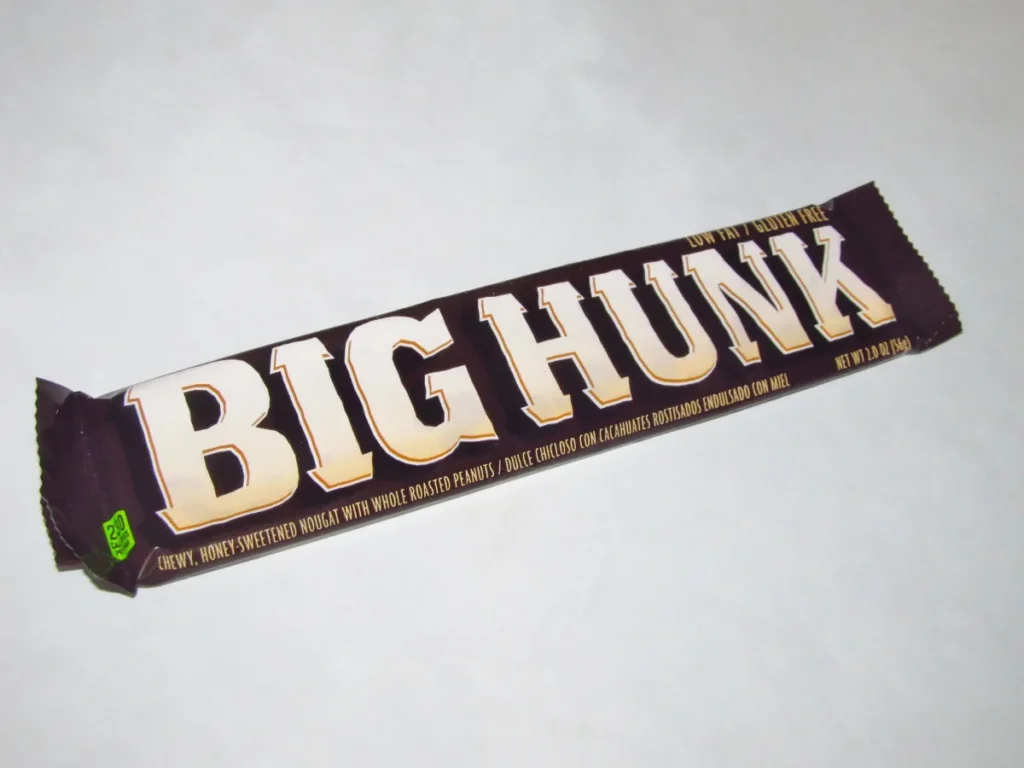
If you grew up out West, you might remember Big Hunk: a long, chewy slab of honey-sweetened nougat packed with whole roasted peanuts. In more recent years, the wrapper even told you to give the bar a good whack against something hard, so it cracks into pieces.
It goes back further than the 1960s. Golden Nugget, the San Francisco company that made it, said in its trademark filing that Big Hunk was on sale by 1936. In 1965, Golden Nugget was sold to Lorillard, the cigarette company, and in the early 1970s Big Hunk went to a Bay Area candy maker, Annabelle’s.
Still made? Waiting to hear. In July 2024, Annabelle’s announced it would close its Hayward, California, plant and said Big Hunk would be made at other facilities. When we checked in late October 2026, the official online store was paused and Big Hunk showed sold out.

26. Goldenberg’s Peanut Chews
If you grew up anywhere between Baltimore and New York, you probably knew these: chewy, chocolatey pieces loaded with roasted peanuts. The Goldenberg family made them in Philadelphia, and the company dates them to 1917. It says they started out as a ration for American soldiers in World War I.
In 2003, Just Born of Bethlehem, Pennsylvania, bought the brand and tried to take it national. The wrapper was redesigned, and the Goldenberg name nearly disappeared from it. The national push was later scaled back, and in 2011 the family name went back on the front, The Philadelphia Inquirer reported.
Still made? Yes. In October 2026, the Peanut Chews website, run by Just Born, still listed Original Dark and Milk Chocolatey Peanut Chews. A year earlier, Philadelphia’s WPVI-TV reported that they were still made in Philadelphia, about 1.2 million pieces a day.
25. Cherry Mash
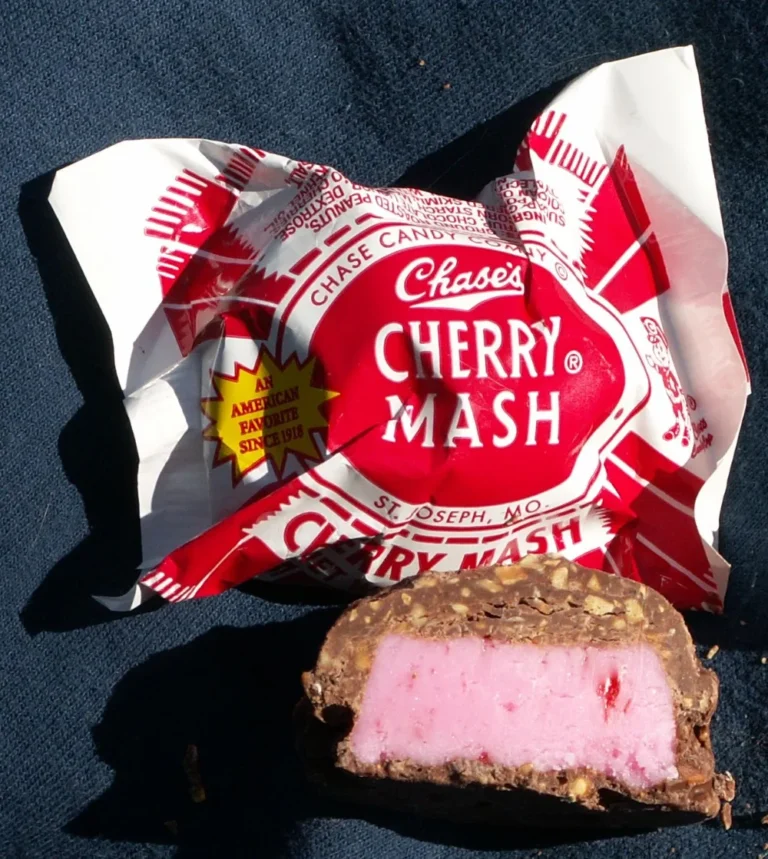
A soft cherry-flavored center, covered in chopped roasted peanuts and chocolate, in a red-and-white wrapper the Chase Candy Company says hasn’t changed since 1930. Chase, of St. Joseph, Missouri, dates the first Cherry Mash to 1918; its trademark filing gives 1928 as the year of first use.
For a few years, it was a Chicago candy. Chase bought Chicago’s Bunte Brothers in 1954 and ran the business from there until 1961, when it closed the Chicago plant and came home to St. Joseph, according to the Encyclopedia of Chicago.
Still made? It’s still on sale, under a new owner. Chase General, the small public company behind Cherry Mash, reported that on August 31, 2026, its candy subsidiary, behind on a loan, handed substantially all of its business assets to the lender, G.W. Chase Candy Company LLC. Chase General said it would wind up its affairs. When we checked in late October 2026, the Chase Candy online store was still selling Cherry Mash.

24. Twin Bing
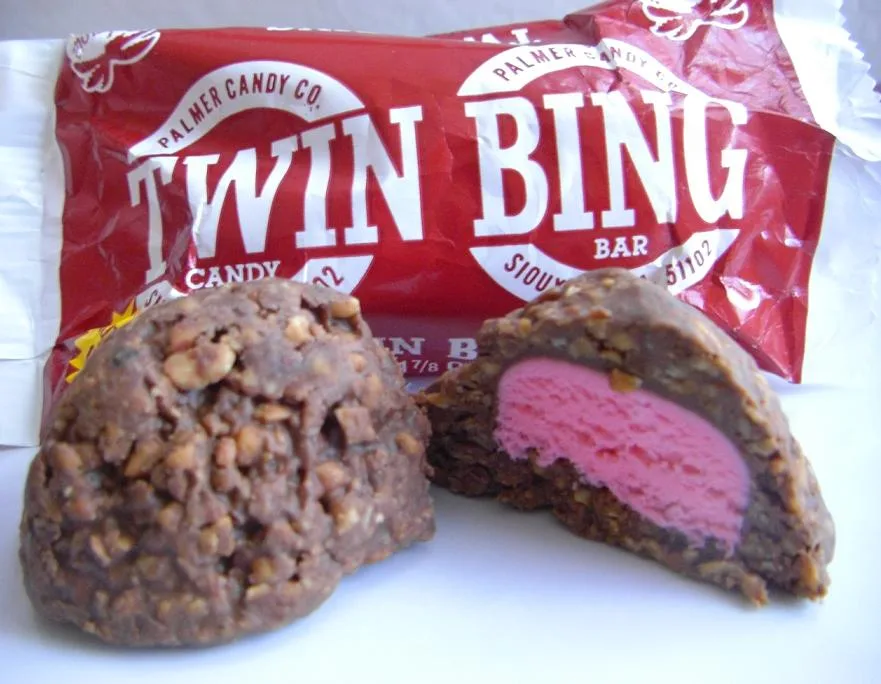
Two mounds to a package, each one chocolate and chopped peanuts around a cherry-flavored center. Palmer Candy of Sioux City, Iowa, has been in the same family since 1878. Its Bing bar dates to 1923, and it first came in four flavors: cherry, vanilla, pineapple and maple.
Why two? Rising ingredient costs had been shrinking candy bars so they could still sell for a nickel, Marty Palmer, whose family runs the company, told the Sioux City Journal in 2011. When prices went from a nickel to a dime in the 1960s, there was no way to make the single Bing any bigger, so a second hump was added. That also kept the Bing a good fit for vending machines. As Palmer put it, someone at the company had the idea that “you could put two together and make it a twin.”
Still made? Yes. You can order Twin Bings from Palmer’s in Sioux City.

23. Nut Goodie
If you grew up in Minnesota, you probably knew the red, green and white wrapper on sight. Inside: a maple cream center under milk chocolate and peanuts. Pearson’s of St. Paul says it developed the recipe in 1912. It sold for a nickel then, and by the late 1950s, a dime.
The Pearson family sold the company at the end of the 1960s, and the new owners changed the recipe, to cut costs and to suit what they thought customers wanted. Around 1980, another owner swapped the familiar wrapper for a new one in brown, red, yellow and white. Customers didn’t like the changes, and sales fell, according to MNopedia, the Minnesota Historical Society’s encyclopedia. In the mid-1980s, longtime employees bought the company and brought back the old recipe and the old wrapper.
Still made? Waiting to hear. Pearson’s St. Paul factory closed on September 28, 2026. The owners said they were looking to move “certain key brands” to a partner, and when we checked in late October, they hadn’t said which brands, or where. Pearson’s website still lists the Nut Goodie.
22. Idaho Spud
It’s not a potato, but it’s shaped like one: a cocoa-flavored marshmallow center, coated in dark chocolate and sprinkled with coconut. The Idaho Candy Company traces its start to 1901, when T.O. Smith began making candy at home in Boise. In 1909 the company built a factory, and it says it still makes candy there. The Spud came along in 1918.
Still made? Yes. You can order the Spud straight from the company in Boise.
21. Goo Goo Cluster
Caramel, marshmallow nougat and roasted peanuts in milk chocolate, shaped into a round cluster instead of a bar. Nashville’s Standard Candy Company says it first made them in 1912, hand-dipped and sold unwrapped under glass at drugstore counters.
If you listened to the Grand Ole Opry, you likely heard about Goo Goos. Under Howell Campbell Jr., who sold the company in 1974, Standard became a sponsor of the show, according to the Tennessee Encyclopedia, and the company still quotes its old line: “Go get a Goo Goo, it’s good!” Hearing about a Goo Goo and finding one weren’t the same thing, though. Around 1980, the encyclopedia says, the 35-cent Goo Goo was hard to find outside Nashville. New owners pushed it into chain stores in the 1980s.
And despite what you might have heard, Goo Goo doesn’t stand for Grand Ole Opry. The candy dates to 1912; the radio show’s familiar name came later, in 1927.
Still made? Yes. Nashville’s Standard Candy Company still sells Goo Goos on its website.
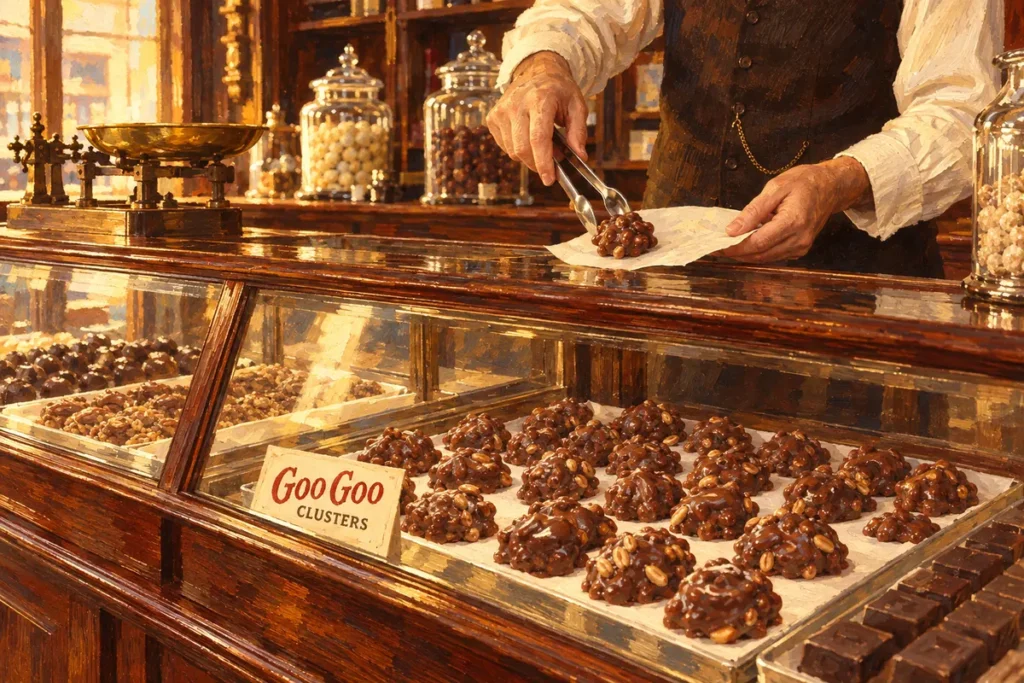
20. Rocky Road
One of Annabelle’s best-known bars: chewy marshmallow, milk chocolate and roasted cashews. Sam Altshuler formed the Annabelle Candy Company in 1950 and named it after his daughter, and the company’s trademark filing dates Rocky Road to that same year.
Here’s a surprise: Annabelle’s didn’t invent rocky road. Candy shops on the Pacific Coast were selling chocolate, marshmallow and nut candy under that name in the 1920s. One Seattle ad is from 1925, a few years before Dreyer’s famous rocky road ice cream. What Altshuler made was a wrapped candy bar, with cashews.
Annabelle’s moved to Hayward, California, in 1965. In July 2024, its owners announced that the plant would close that September, and said Rocky Road would be made at other facilities.
Still made? Waiting to hear. When we checked in late October 2026, the official online store was paused, and all four Rocky Road flavors showed sold out.
If you’d like to make candy with chocolate, marshmallow and nuts at home, our free recipe for Mamie Eisenhower’s Million Dollar Fudge is made with marshmallow creme.
19 to 11: Abba-Zaba to Whiz
19. Abba-Zaba
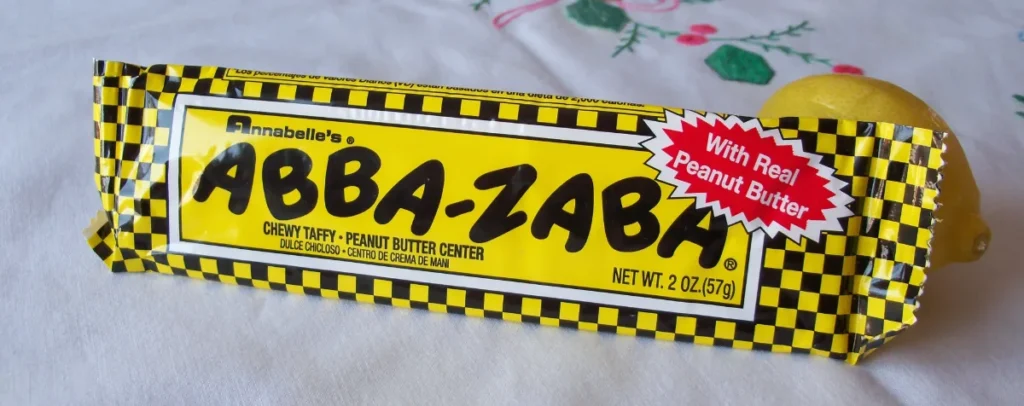
That yellow-and-black checkerboard wrapper, and inside, a chewy taffy bar with a creamy peanut butter center. Its trademark record dates the first sale to Valentine’s Day, February 14, 1922, and the bar is usually credited to a company called Colby and McDermott. By most accounts, it came to Annabelle’s in 1978.
Still made? Waiting to hear. Abba-Zaba was one of the bars the owners said would carry on when they announced the Hayward plant’s closing, but in late October 2026 it was sold out on the official store, too.

18. Valomilk
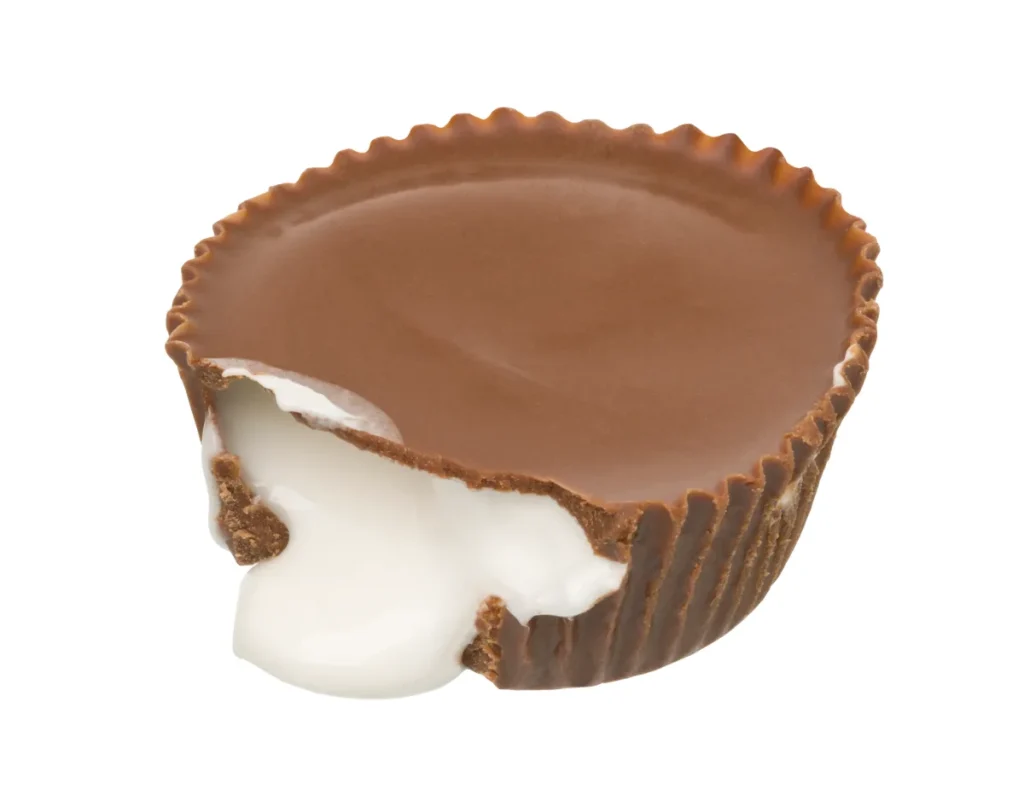
Bite through the chocolate cup, and the center doesn’t stay put. It flows: soft vanilla marshmallow that runs.
That’s because it started as a mistake, the Sifers family says. A candy maker in Kansas City put too much vanilla in a batch of marshmallow, and it wouldn’t set. In 1931 the family sold it as Valomilk Dips, for a nickel, and later shortened the name. During World War II, with chocolate scarce, the company put the chocolate it had into Valomilks instead of boxed chocolates.
In 1970 the business was merged into a Los Angeles company, which the family says didn’t work out, and in 1981 the Kansas City factory shut down. Four years later, Russ Sifers bought back his great-grandfather’s copper kettles and started over in Merriam, Kansas.
Still made? Yes, by the Sifers family in Merriam, and the center still runs. The company says it can’t sell directly to consumers.

17. Zero
A candy bar with a white coating instead of chocolate. Today’s Zero has caramel and peanut-and-almond nougat inside.
Hershey says Zero was created in 1920 by the F.A. Martoccio Macaroni Company. Yes, a pasta company. Frank Martoccio had been making macaroni until one of his factory engines burned out, and he ended up buying an entire candy plant, according to a 1986 history in American Heritage. His company became Hollywood Brands, and in 1938 it moved to Centralia, Illinois.
The same history credits Martoccio with a synthetic candy coating that stayed hard in hot weather. And in 1954, Hollywood sold Zero with a mascot: “Zero, the little Hollywood candyman.”
Still made? Yes. Hershey makes it.
16. 5th Avenue
A candy bar from a cough drop company. Luden’s of Reading, Pennsylvania, introduced 5th Avenue in 1936: crunchy layers of peanut butter in a chocolate coating.
Hershey bought Luden’s in 1986, and the bar is still around. But it isn’t quite the bar people describe. Hershey’s own page says the original was topped with toasted almonds, and today’s ingredient list has none. One major grocer now lists it as “chocolatey coated.” When the almonds went, sources don’t agree.
Still made? Yes, by Hershey, just a little different from the one you may remember.
15. The Bun
A round, lumpy cluster: a soft maple or vanilla cream center, buried under peanuts and chocolate. In the ’60s and ’70s, the Bun came out of Fort Wayne, Indiana, from a company called Wayne Candies. It even had its own slogan, registered in 1967: “It’s Fun to Eat a Bun.” A 1968 newspaper ad, cited by local historians, offered a five-pack for 39 cents.
By 1974, Wayne Candies belonged to Curtiss, the Baby Ruth company, and local historians say the Reggie! bar was made right there in Fort Wayne, essentially a caramel Bun in a new wrapper. So the bars that rained down on Yankee Stadium may have been, more or less, Fort Wayne Buns wearing Reggie Jackson’s picture.
When the plant’s closing was announced in 1981, that ended the original Reggie! bar. But the plant itself was sold, and it kept making Buns until 1995. Then the Bun moved to the Pittsburgh area, and in 1998 to Pearson’s of St. Paul, the Nut Goodie people.
Still made? Waiting to hear. The Bun was made in the St. Paul factory that closed on September 28, 2026. Pearson’s still lists maple and vanilla Buns but hasn’t said whether, or where, they’ll be made again.
14. Big Time
This one sold on size. Big Time was a Hollywood bar of nougat, peanuts and caramel, and a candy wrapper museum describes it as an eighth of a pound. One store box carried the slogan “Big Time—Big Deal!”
Hollywood’s trademark filing says Big Time was first sold in February 1940, and the company was still renewing the name in 1975.
Still made? No. We couldn’t establish when the last Big Time was made.
13. Butter Nut
Another Hollywood bar, in an orange wrapper that said it was caramel and peanuts. In 1980, a fire destroyed Hollywood’s original plant in Centralia. The company later passed to Leaf, and in 1996 Leaf’s North American candy business went to Hershey. Butter Nut eventually disappeared, but the records we found don’t establish its final production date.
Still made? No. Of the four Hollywood bars on this list, only Zero is still made. Hollywood’s PayDay is still on the shelf, too.
12. U-No
A smooth milk chocolate bar with a truffle-like center, covered in milk chocolate and ground almonds. That’s how its maker describes U-No.
It came from Cardinet’s, an Oakland candy company, and its trademark says it was on sale by 1924. You’d find it in West Coast drugstores: a 1970 Longs Drugs ad listed U-No bars right next to another Cardinet bar, Baffle. Raymond Carver even put U-Nos in a story. In his 1976 collection, a man at the checkout counter “added a handful of U-No bars to the order.”
By the mid-’70s, Cardinet’s belonged to Ralston Purina, the St. Louis company behind Purina Dog Chow. Ralston registered the U-No name in 1975, and in 1978 it sold Cardinet to Annabelle’s.
Still made? Not that we could find. When Annabelle’s announced the Hayward plant’s closing in 2024, U-No wasn’t among the bars the owners said would carry on. Its page is still up on the official store, with the words “Enjoy a U-NO today!” But there are no bars on it.
11. Whiz
Whiz came from the Paul F. Beich Company of Bloomington, Illinois: chocolate fudge, marshmallow and peanuts. It started in 1922 as a ten-cent bar. In the Depression it dropped to a nickel, and that’s when it got its slogan, “best nickel candy there iz-z,” spelled with z’s to rhyme with Whiz. Rising costs in the 1950s pushed it back up to a dime, a candy historian wrote.
Beich kept advertising it into the ’70s. The history museum in Bloomington holds a Whiz comic-strip ad from 1971. Then, in January 1973, the hometown paper ran the headline: “Whiz – it’s out of biz.”
Still made? No.
Bonus: could you buy a Wonka Bar in 1971?
Before the top ten, a famous bar with a murky story. Quaker Oats helped finance Willy Wonka & the Chocolate Factory, which opened in the summer of 1971, to sell candy. But the bar itself never quite worked out, and accounts differ. One says the bars were pulled from distribution at the last minute. A CBC radio history says the candy kept melting and was eventually pulled from the shelves. The American Film Institute’s catalog says the bar was never successfully manufactured. The Wonka name reached candy racks later, and we found no dated ad for a Wonka Bar on sale in 1971.
10 to 1: No Jelly to the Marathon
10. Peanut Butter with No Jelly
That was the name. In the early ’70s, Peter Paul, the Connecticut company behind Mounds and Almond Joy, gave peanut butter a bar of its own and made the name the joke. The ads called it “the new peanut butter candy bar from Peter Paul”: real peanut butter, dotted with crispies, in milk chocolate.
It wasn’t hidden away, either. Grocery ads in the early and mid-’70s listed it right alongside Mounds and Almond Joy, and in September 1975, an Ohio store sold bite-size Almond Joy, No Jelly, Mounds or Caravelle in bags of three-quarters of a pound. Peter Paul put it on television, too. Duke University’s advertising archive holds several No Jelly commercials from the 1970s.
The brand’s trademark record dates its first sale to June 1971 and records continued use in 1978. We couldn’t pin down when production ended.
Still made? No. Peanut butter, no jelly, and in the end, no bar.
9. Power House
Peter Paul again, but with a bar it didn’t invent. Power House started in Chicago with the Walter H. Johnson Candy Company, which registered the name in 1937.
People remember it as a big bar. One published memoir recalls “a huge Power House candy bar” that cost a nickel, and by the 1970s the wrapper said 2.2 ounces. In 1950, Power House sponsored the early TV space hero Captain Video, and kids could get premiums like rings and even a plastic ray gun.
In the mid-’60s, Peter Paul paid three million dollars for the Johnson company and its Power House bar. It was still being made in 1983. Its final production date remains unclear.
Still made? No.
8. Chicken Dinner
No chicken. Not a bit. Chicken Dinner was a chocolate-covered nut roll, made with peanuts and caramel, from the Sperry Candy Company of Milwaukee. Like Whiz, it started out at a dime and later dropped to a nickel.
Sperry introduced it in the early 1920s, and its 1924 trade ad said the name suggested “the best of something good to eat.” You’ll sometimes hear it was named for the “chicken in every pot” promise of Herbert Hoover’s 1928 campaign. But the bar came first, by about five years. And the roast chicken on the first wrappers? A 1986 history says it took Sperry several years to drop it, though the name stayed.
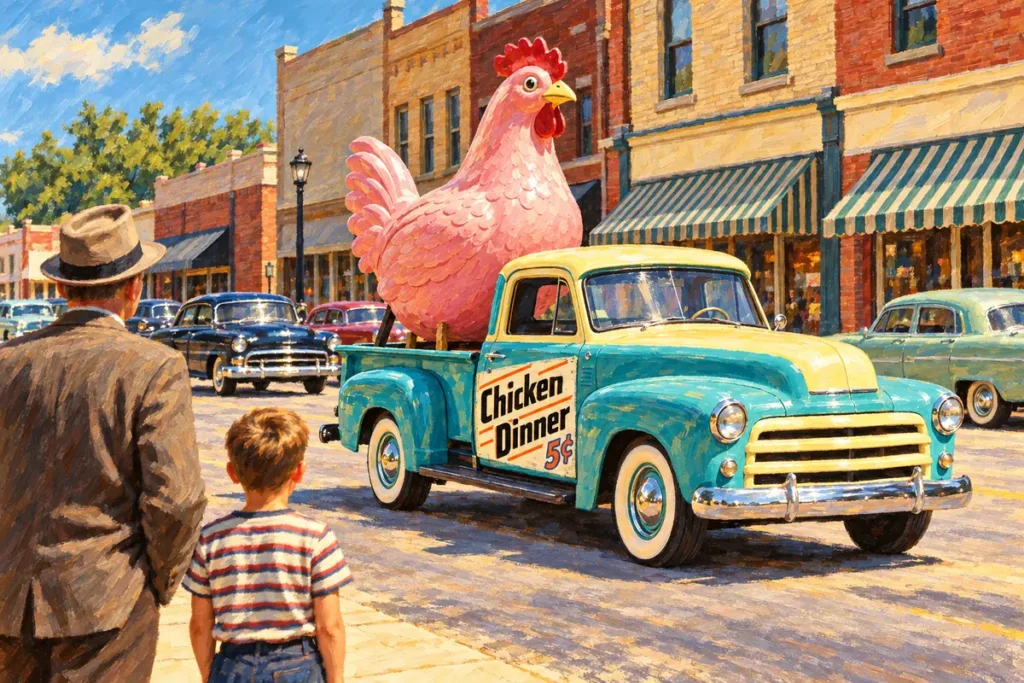
If you remember Chicken Dinner, you may remember the trucks. Sperry put giant chickens on its cars and trucks by 1926, and a photo slide from 1956 shows a big pink chicken riding a pickup in Milwaukee.
In 1962, Pearson’s of St. Paul bought Sperry, and most sources say Chicken Dinner ended around then. One historian thinks it lasted longer.
Still made? No.
7. Choco’Lite
Nestlé called it “whipped milk chocolate with crispy chips”: an airy chocolate bar with crunchy bits all through it. It arrived in the early ’70s; sources put the launch somewhere between 1971 and 1973. By 1976 it was on Chicago television, in a commercial called “A Mouthful of Chocolate,” where store cashiers break into a song and dance to explain it.
Still made? No. Accounts put its end sometime in the 1980s.
6. Nestlé’s Triple Decker
You’ll often read that Triple Decker was dark, white and milk chocolate. But Nestlé’s own newspaper ads from the fall of 1962 described smooth, light milk chocolate and rich, sweet dark chocolate, with “a luscious bon-bon layer between.”
Nestlé’s trademark filing says Triple Decker was on sale by August 1960. In 1962, The New Yorker printed the company’s own explanation of where it came from: the new bar was “borrowed from our English firm.”
Still made? No. It seems to have faded out sometime in the ’70s, and by the mid-1980s, candy historian Ray Broekel listed it among the bars no longer made.
5. The American Mars bar
Ask for a Mars bar in London, and you’ll get something an American would call a Milky Way. Forrest Mars built the British Mars bar in 1932 on the Milky Way formula.
The American Mars bar was a different candy: nougat and toasted almonds in milk chocolate. Old display boxes called it the Mars Toasted Almond Bar, and a 1950 Life ad said it was “like a chocolate nut sundae.” By the 1970s, a wrapper shows, it was a 1.4-ounce bar for fifteen cents.
Around 2002, the American Mars bar was dropped, and its spot went to Snickers Almond: almonds and nougat, plus caramel. In 2017, Mars brought the original back through its Ethel M chocolate shops.
Still made? Not that we could find. The closest thing on the rack is Snickers Almond. Close, but not the same.
4. Caravelle
Chocolate, chewy caramel and crisped rice, from Peter Paul, the No Jelly and Power House company. Remember those 1975 bite-size bags? Caravelle was one of them.
Peter Paul launched it in the mid-’60s, and its hometown historical society says it was voted best new candy of 1967. It had a close competitor in Nestlé’s Hundred Thousand Dollar Bar, advertised by October 1964, with the same combination of chocolate, caramel and crisped rice. Peter Paul advertised Caravelle on television in the ’70s, and three of those commercials survive in the same Duke University collection.
Still made? No. Caravelle eventually disappeared, though accounts disagree about exactly when. Its old rival survives as 100 Grand.
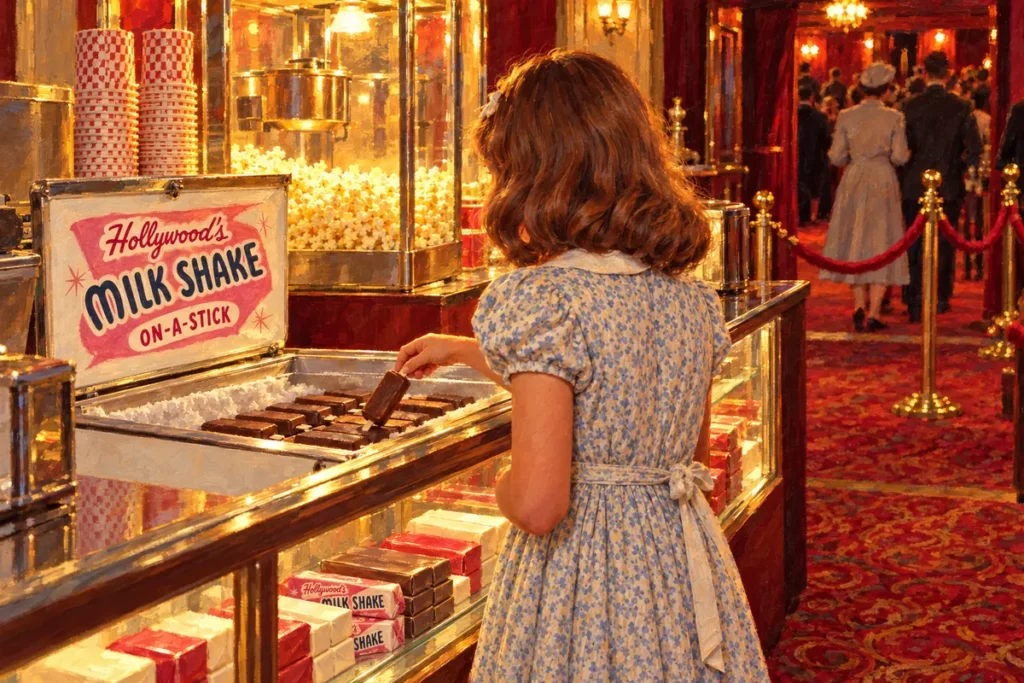
3. Milk Shake
Another Hollywood bar, and the one its maker told movie theaters they could sell frozen. Its trademark filing says it was first sold in September 1927, and Hollywood described it as malted milk nougat with a layer of caramel on top, in a rich coating.
Hollywood pitched it straight to theaters. A 1954 trade advertisement offered Milk Shake On-A-Stick, told theater owners it could be frozen, and promised that summer heat needn’t hurt their candy sales. By 1959, Hollywood was promoting a nearly quarter-pound Milk Shake for fifteen cents, answering demand especially from theaters. Hollywood’s president called it “practically a full meal.”
And at least one person remembers them frozen: the curator of an online candy wrapper museum recalls buying Milk Shakes that way at a swim club.
Still made? No.
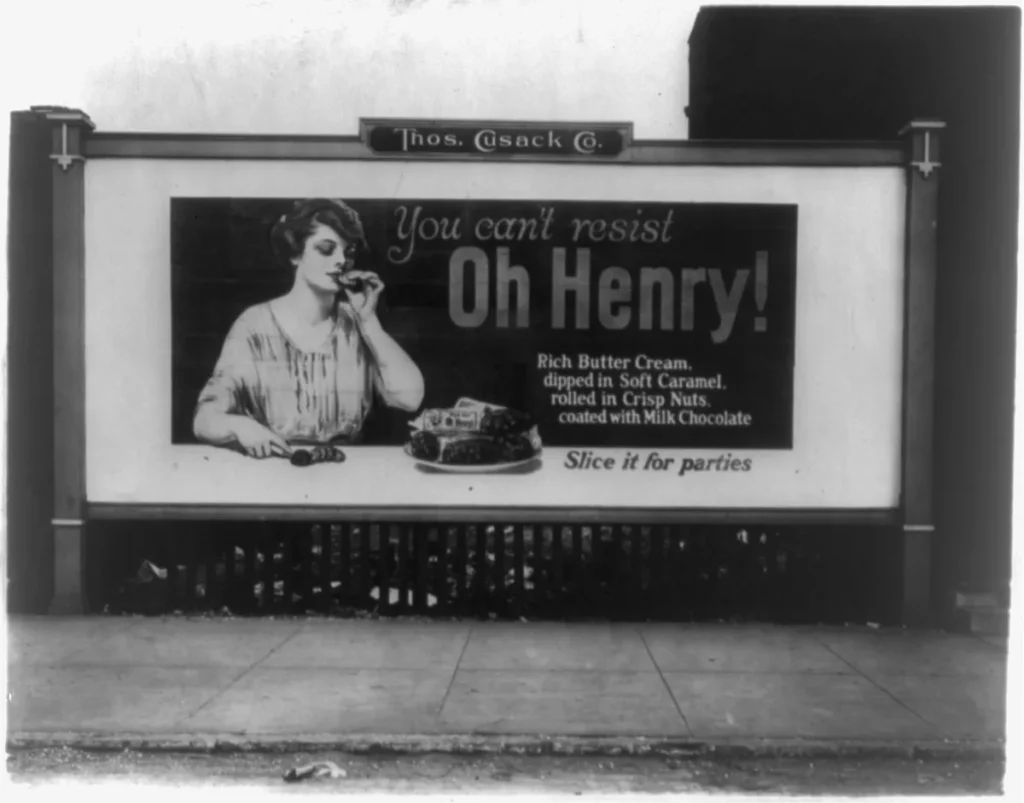
2. Oh Henry!
A Chicago candy bar born in 1920. Oh Henry! came from the Williamson Candy Company: peanuts and caramel in chocolate. In 1974, its owner even filed for an “Oh Henry! Home Run Bar,” claiming it was first sold on April 11, three days after Hank Aaron broke Babe Ruth’s home run record.
The brand changed hands several times over the years, and in 2018 it went to Ferrero, along with the rest of Nestlé’s American candy. Then, around 2019, the American Oh Henry! vanished from U.S. racks. Its U.S. owner doesn’t list it today, and we found no announcement.
Still made? Not in the U.S. Hershey has sold Oh Henry! in Canada since 1987. Hershey’s Canadian bar has peanuts, caramel and fudge, but a Chicago museum says it uses a different recipe. If you miss it, import sellers will ship one down from Canada.
1. Marathon
Mars introduced it in 1973: eight inches of braided caramel, covered in chocolate. Printed on the wrapper was an eight-inch ruler, along the back on the mid-’70s wrappers and down the edge on later ones, so you could hold up the bar and check that you’d gotten all eight inches. An early wrapper even had the price printed right on it: fifteen cents.
And it came with a promise: you couldn’t rush it. By December 1973, the newspaper ads featured a character called Marathon John, and on TV he told a character called Captain Quick that you can’t eat a Marathon fast. A 1999 newspaper story said Mars took it off the shelves in 1981, when sales didn’t meet expectations.
Still made? No. As far as we could find, Mars makes no braided caramel bar today. The closest thing may be Cadbury’s Curly Wurly, a British chocolate-and-caramel lattice from 1970 that turns up in import shops. The full story, including the British “Marathon” that was really a Snickers, is in What happened to the Marathon candy bar?
Common questions
What candy bars from the 70s were discontinued?
From this list, the Marathon (1973 to 1981), Whiz (gone by January 1973), Peanut Butter with No Jelly, Choco’Lite, Caravelle, Power House and Butter Nut were all sold in the ’70s and are no longer made. Nestlé’s Triple Decker seems to have faded out in the ’70s, too. Others lasted longer: the American Mars bar was dropped around 2002, and Oh Henry! left American racks around 2019.
Which old candy bars are still made?
From this list, as of October 2026: Twin Bing (Palmer Candy, Sioux City, Iowa), Idaho Spud (Idaho Candy Company, Boise), Goo Goo Cluster (Standard Candy, Nashville), Valomilk (the Sifers family, Merriam, Kansas), Goldenberg’s Peanut Chews (Just Born), and Hershey’s Zero and 5th Avenue. Cherry Mash is still on sale from the Chase Candy online store, after its maker’s assets passed to a lender in 2026. The Reggie! bar is back under license, and Oh Henry! is still sold in Canada.
How much did a candy bar cost in the 1970s?
It depended on the bar and the store. On this list, a 1970s American Mars bar wrapper shows fifteen cents, an early Marathon wrapper had fifteen cents printed on it, and the Reggie! bar cost a quarter in 1978. A decade earlier, a 1968 ad offered a five-pack of Buns for 39 cents. For the nickel Hershey bar, and the year that nickel price ended, see our list of 21 dime store candies from the 1960s.
Which bar did you look for on the rack, and in what town? Tell us in the comments on the video.
Keep the memories going
- 1970s party snacks — 38 homemade treats, from onion dip to seven-layer bars.
- What happened to the Marathon candy bar, the 8-inch bar with a ruler
- 21 dime store candies from the 1960s, and which ones still exist
- 1960s Halloween candy: treats, memories and the “banned” myths
- Mamie Eisenhower’s Million Dollar Fudge: the recipe and its history
Sources and further reading
- Reggie!: SABR Games Project: April 13, 1978; National Baseball Hall of Fame: the Reggie! bar; Barry Popik: “If I played there, they’d name a candy bar after me”; Allen County Genealogical Society of Indiana: Wayne Candy, Fort Wayne; The Reggie! Bar
- Big Hunk: BIG HUNK trademark record; Local News Matters (Bay City News), 2019: the Golden Nugget candy company; Candy Addict, 2007; Annabelle Candy: Big Hunk
- Goldenberg’s Peanut Chews: Peanut Chews; The Philadelphia Inquirer, 2011; WPVI-TV (6abc), Oct. 21, 2025
- Cherry Mash: Chase Candy: Our Legacy; CHERRY MASH trademark record; Encyclopedia of Chicago: Bunte Bros.; Chase General Corporation, Form 8-K, filed July 24, 2026; Chase General Corporation, Form 8-K, filed Sept. 2, 2026; Chase Candy store
- Twin Bing: Palmer Candy: Our History; Nick Hytrek, “Twin Bing name was a natural,” Sioux City Journal, Jan. 31, 2011; Palmer Candy store
- Nut Goodie: MNopedia: Pearson’s Nut Goodie candy bar; Pearson’s: Heritage; FOX 9, July 30, 2026; MPR News, Sept. 28, 2026
- Idaho Spud: Idaho Candy Company
- Goo Goo Cluster: Goo Goo Cluster: About; Tennessee Encyclopedia: Standard Candy Company; NPR, 2012: Grand Ole Goo Goo; Tennessee Encyclopedia: Grand Ole Opry
- Rocky Road: Candy Hall of Fame: Samuel Altshuler; ROCKY ROAD trademark record; Barry Popik: rocky road; J. The Jewish News of Northern California, 2018; Annabelle Candy Co. release, July 31, 2024; Snack Food & Wholesale Bakery, 2024; Annabelle Candy: Rocky Road
- Abba-Zaba: ABBA-ZABA trademark record; Berkeleyside, 2017; Annabelle Candy: Abba-Zaba
- Valomilk: Valomilk: History; Valomilk; The Retroist, 2009: an interview with Russ Sifers
- Zero: Hershey: Zero; American Heritage, 1986: “Land of the Candy Bar”; The Seattle Times, 1996; Hollywood Brands ad, Motion Picture Herald, 1954
- 5th Avenue: Hershey: 5th Avenue; Kroger: 5th Avenue
- The Bun: Allen County Genealogical Society of Indiana: Wayne Candy, Fort Wayne; Pearson’s: BUN; Bun Bars (Wikipedia)
- Big Time: BIG TIME trademark record; Candy Wrapper Museum: Big Time
- Butter Nut: Candy Wrapper Museum: Butter Nut; The Seattle Times, 1996; Hershey Foods, Form 10-K for 1996; Hershey: PayDay
- U-No: U-NO trademark record; The Post, Daly City edition (Calif.), Oct. 7, 1970; Raymond Carver, Will You Please Be Quiet, Please? (1976); Ray Broekel, The Chocolate Chronicles (1985); Snack Food & Wholesale Bakery, 2024; Annabelle Candy: U-NO
- Whiz: McLean County Museum of History: Paul F. Beich; Beich Collection finding aid; American Heritage, 1986: “Ten Immortals”
- Wonka Bar: AFI Catalog: Willy Wonka and the Chocolate Factory; Brandchannel, 2011 (archived copy); CBC Radio, Under the Influence: the real reason Charlie became Willy Wonka
- Peanut Butter with No Jelly: NO JELLY trademark record; Sunday Journal and Star (Lincoln, Neb.), Nov. 26, 1972; Record-Herald (Washington C.H., Ohio), Sept. 13, 1975; Duke University AdViews: Peanut Butter with No Jelly
- Power House: POWER HOUSE trademark record (USPTO); TIME, 1967: “Mounds of Joy”; TIME, May 22, 1950; The Official Hake’s Price Guide to Character Toys; We Are Leaving at a Rapid Rate (2006); Candy Wrapper Archive: 1970s Power House; UPI, April 27, 1983; Naugatuck Historical Society: Peter Paul
- Chicken Dinner: Samira Kawash, Candy Professor: “Chicken Dinner is not for Dinner”; American Heritage, 1986: “Ten Immortals”; Indiana Memory: Sperry Candy Company fleet, Vincennes, Indiana; Forensic Genealogy: the 1956 Milwaukee slide; Mental Floss, 2015
- Choco’Lite: Nestlé Choco’Lite commercial, “A Mouthful of Chocolate” (1976); Candy Wrapper Museum: Choco’Lite
- Nestlé’s Triple Decker: NESTLE’S TRIPLE DECKER trademark record; Independent Press-Telegram (Long Beach, Calif.), Nov. 4, 1962; The New Yorker, Feb. 17, 1962; Ray Broekel, The Chocolate Chronicles (1985)
- The American Mars bar: Made-in-Chicago Museum: Mars Inc.; 1950 Mars Bar Toasted Almond ad (RISD Library); Candy Wrapper Archive: 1970s Mars; Ethel M Chocolates release, 2017; Snickers Almond
- Caravelle: TIME, 1967: “Mounds of Joy”; Naugatuck Historical Society: Peter Paul; CollectingCandy: 50 years of the 100 Grand bar (archived copy); Duke University AdViews: Caravelle commercial, 1970s; Ferrero U.S.: all brands
- Milk Shake: MILK SHAKE trademark record; Hollywood Brands ad, Motion Picture Herald, 1954; Motion Picture Exhibitor, Feb. 11, 1959; Candy Wrapper Museum: Milk Shake
- Oh Henry!: Made-in-Chicago Museum: Williamson Candy Co.; OH HENRY! HOME RUN BAR trademark record; The Shelby Report, 2018; Ferrero U.S.: all brands; The Hershey Company, 2020 Factbook; National Baseball Hall of Fame: Henry Aaron hits home run No. 715
- Marathon: The Christian Science Monitor, March 18, 1999; Fonts In Use: Marathon chocolate caramel; Candy Wrapper Museum: Marathon; Mars: Our Brands; English Tea Store: Cadbury’s Curly Wurly
Historical details checked October 2026. Company dates are the companies’ own claims, and trademark “first use” dates are the owners’ own claims. Availability was checked in October 2026 and can change.